Dive Brief:
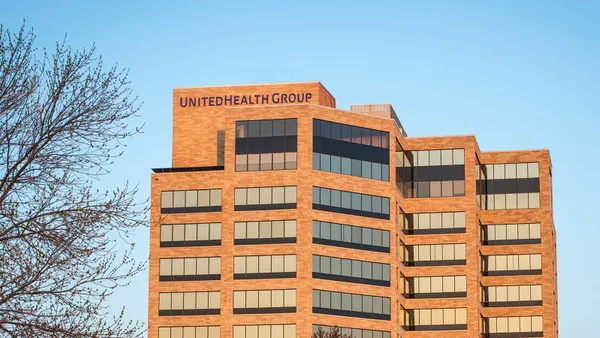
- UnitedHealth raised its 2026 earnings guidance for the third time this year on Tuesday, after reporting soaring profits despite revenue slippage in a better-than-expected third quarter.
- UnitedHealth brought in profit of $4.1 billion in the quarter, up 75% year over year, on revenue of $112.7 billion, down 0.4%, as the healthcare behemoth’s strategy of culling members to improve margins continues to bear fruit.
- During a call with investors Tuesday morning, executives said they are confident heading into Medicare open enrollment and see opportunities for growth in lucrative markets like special needs plans next year. Though, the insurer continues to see pressure in its commercial business as a result of the No Surprises Act arbitration process.
Dive Insight:
Surging healthcare utilization and medical costs weighed heavily on insurers’ bottom lines in 2024 and 2025. UnitedHealth was no exception. But the Minnesota-based healthcare giant has made progress this year, outperforming analysts’ expectations and boosting its 2026 outlook in the first, second and now third quarters — signs of momentum that have boosted investors’ conviction in the turnaround.
UnitedHealth “delivered another solid quarter ... reinforcing our confidence that the company remains on track,” Morgan Stanley analysts wrote in a note.
Payer arm UnitedHealthcare and care delivery unit Optum Health — the businesses recovering from the most drastic profit degradation — both reported stronger earnings than Wall Street had expected, thanks to plan cuts and other actions that’ve yielded fewer but more profitable members.
UnitedHealth’s medical loss ratio, an important marker of spending on patient care, fell to 88.4% in the quarter, down from 89.9% same time last year. That means the company was able to keep a greater share of patient’s premium dollars for administrative expenses — and for profits.
Optum Health reported $735 million in operating income in the quarter, almost 18 times higher than in the same time last year. Meanwhile, UnitedHealthcare brought in $2.8 billion in operating profit, $1 billion more than in the prior year.
Much of the insurer’s future progress depends on continued margin improvement in its Medicare Advantage business. UnitedHealthcare hiked premiums, cut benefits and dropped unprofitable plans coming into this year, sending its MA membership plummeting — the insurer expects to lose more than 1 million enrollees in its privatized Medicare plans in 2026.
But that sacrifice has driven higher profits: UnitedHealthcare expects to end 2026 at the high end of its 2% to 4% margin range, Bobby Hunter, the president of the insurance division, said on the call.
And UnitedHealthcare is well-situated for further recovery in 2027, as a result of additional downsizing — and an emphasis on more profitable markets, Hunter stressed.
For 2027, UnitedHealthcare cut hundreds of MA plans, trimmed benefits and offloaded more costs onto members. The insurer concentrated cuts among traditional MA plans offered to the majority of seniors — especially those with broader provider networks — while prioritizing HMO plans with narrower networks, and expanding special needs plans offered to chronically ill seniors and people dually eligible for Medicare and Medicaid. SNPs typically generate higher per-enrollee margins than other MA plans.
It’s too early to share membership assumptions for 2027, Hunter said. But “I think there’s actually a lot of good growth potential out there,” the UnitedHealthcare leader added.
Yet it’s not all roses for UnitedHealthcare’s MA outlook. The insurer is absorbing a star ratings dip, after seeing the percentage of its members in plans with at least 4 stars fall from 81% in 2026 to 68% for 2027. That’s set to cut into UnitedHealthcare’s MA revenue for 2028, since the quality scores are tied to valuable bonuses and competitive advantages in the program.
Executives tried to assuage investor concerns about the stepdown during the earnings call.
UnitedHealthcare expected the poorer results, after pulling back the generosity of its plans to recover margins this year, according to Hunter.
“We knew there could be some stars pressure related to the repositioning of benefits we did for [2026],” Hunter said.
Moreover, as a result of membership shifts over 2027, the percentage of UnitedHealthcare’s members in plans with at least 4 stars should be closer to 75% by the end of the year, CEO Stephen Hemsley added.
As for UnitedHealthcare’s other divisions, its Medicaid business continues to contend with a “stubborn” gap between state funding and elevated utilization, Medicaid CEO Mike Cotton said. UnitedHealth expects the division to operate at a -1% margin this year, before that gap shrinks and generates improved profitability in 2027 and beyond.
Executives also called out unexpectedly high spending in UnitedHealthcare’s employer-sponsored plans for the second quarter in a row. Providers are billing more aggressively and specialty drugs are getting more expensive. But the biggest issue is UnitedHealthcare being forced to pay out outsized awards in out-of-network disputes with providers under the NSA, Hemsley said.
The payouts account for nearly 6% of UnitedHealthcare’s total medical spend in some regions, translating to billions of dollars in excess costs, the CEO said, calling it “ongoing abuse” by some clinician groups.
“We will continue working with policymakers and regulators to ensure the law functions as intended, and that healthcare dollars are directed towards appropriate patient care rather than significantly inflated market arbitration awards,” Hemsley told investors.
UnitedHealth lifted its adjusted earnings outlook to at least $20.50 per share, up from a previous range of $19.50 to $20, following the results.