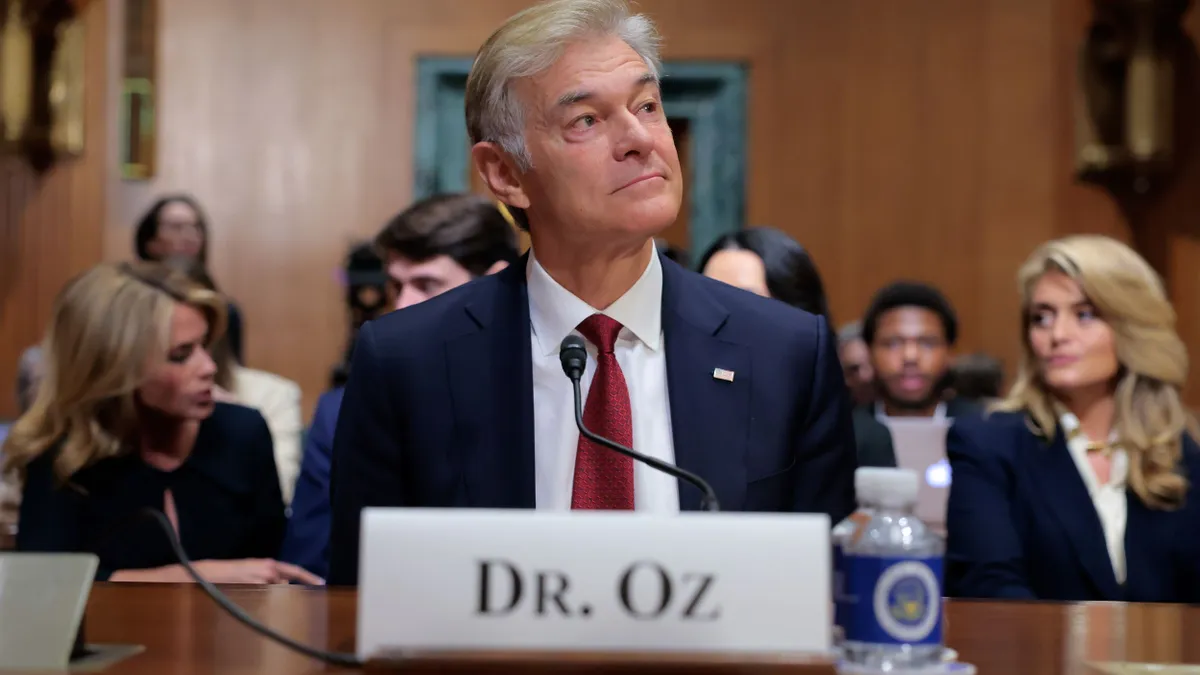

Marty Makary has resigned as the head of the Food and Drug Administration, ending what’s been an unusually tumultuous run steering the U.S.’s top health regulator.
President Trump confirmed Makary’s departure, which was first reported by Politico, at a meeting with reporters on Tuesday. Kyle Diamantas, previously the FDA’s deputy commissioner for food, will serve as the agency’s acting commissioner in Makary’s place.
“Marty's a great guy, he's a friend of mine [and] he's a wonderful man,” Trump said. “He was having some difficulty,” but “he's going to go on and he's going to do well. Everybody wants that job.”
The Department of Health and Human Services didn't respond to a request for comment.
Makary was seen as a traditional pick as the head of the FDA when Trump nominated him in November 2024. A prolific medical researcher and author, he wrote papers on topics from pancreatic surgery protocols to patient safety and healthcare costs.
He also penned several books — among them one called “Blind Spots” that challenged what Makary often described as scientific “groupthink” — and criticized the public health response to the COVID-19 pandemic. Makary sailed through a Congressional confirmation hearing in March 2025.
Makary has since championed measures designed to speed drug development, among them a new type of voucher program, an approval framework for ultra-rare diseases and use of AI in reviews. He also put into place new plans to require only one pivotal clinical trial, instead of the typical two, before a medical product’s approval.
But under his leadership, multiple key officials have resigned amid mass layoffs. Some analysts detected an uptick in delayed drug reviews compared to years past. The agency has also come under fire for unpredictable shifts in guidance and regulatory rejections that frustrated some drugmakers and contrasted with Makary’s goals of flexibility.
“Really the broader takeaway here for us is that FDA — and our ability to predict the FDA — is about as uncertain as it’s been in the past decade or longer,” Paul Matteis, an analyst at the investment firm Stifel, wrote in a note to clients late last year, after the agency appeared to make a surprising about-face on a closely watched gene therapy for Huntington’s disease.
Additionally, there’s been an unusually high level of turnover at the agency’s highest ranks. Vinay Prasad, a vocal critic of the FDA, was named the head of the office that evaluates vaccines and gene therapies in May 2025. He quit two months later, quickly took the job again and then left for a second time at the end of April. Makary hired George Tidmarsh to run the regulator’s other main drug office, CDER, but he resigned in November amid a probe into his conduct.
More recently, Makary tapped Richard Pazdur, a longtime leader of the FDA’s oncology group, to head CDER. Reportedly, Pazdur initially turned down the job and announced plans to retire within weeks, a choice influenced by tensions with Makary and concerns about his plans to drastically accelerate drug reviews. Tracy Beth Høeg, a top Makary aide, has since been named Pazdur’s replacement.
The constant turnover has caused angst within the biotechnology industry, which is starting to rebound from a multiyear downswing. “We need organizational strength and stability at the agency,” said John Crowley, head of the Biotechnology Innovation Organization trade group, in a statement after Pazdur’s retirement announcement. “It is time to right the ship.”
Yet Makary this year continued to draw criticism from multiple places. He reportedly angered anti-abortion groups for not moving quickly enough on a promised safety study of the pill mifepristone, as well as clearing a generic version of the drug. Trump then reportedly pressured Makary into approving flavored vaping products after he’d hesitated to do so.