


LAS VEGAS — Artificial intelligence is inescapable.
Healthcare is AI’s largest vertical market, with spending hitting $3.7 billion this year, according to Menlo Ventures. Absorption with the technology was palpable at HLTH this year.
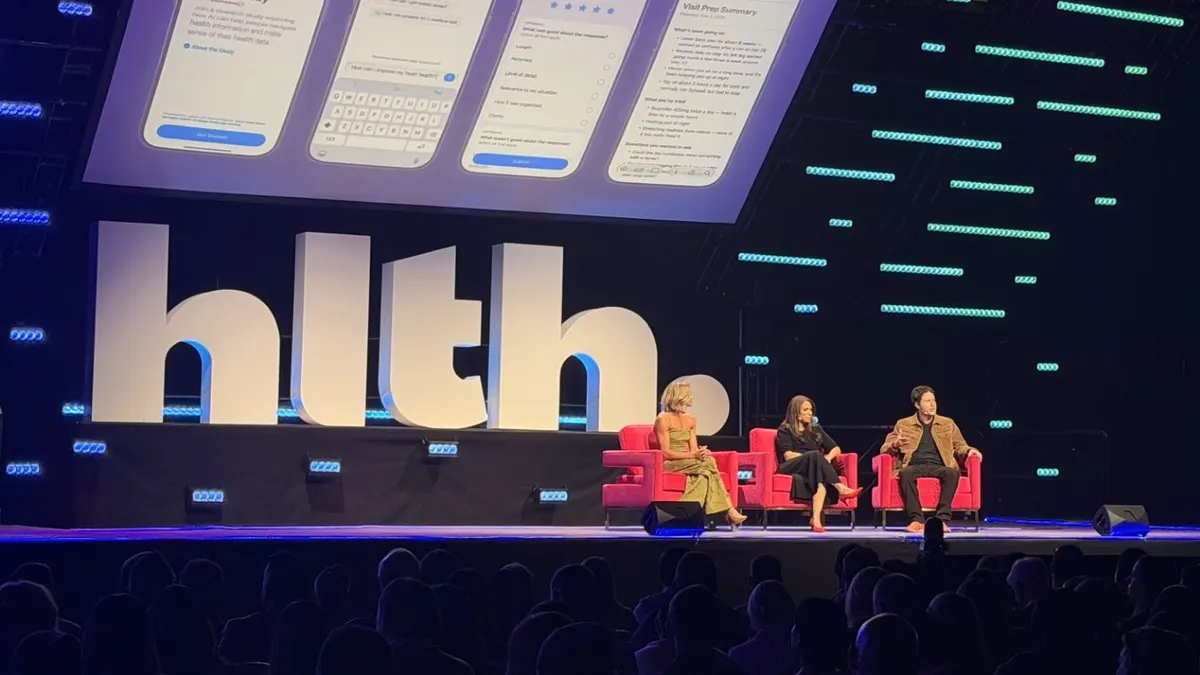
Over four days in Las Vegas, seemingly every booth on the show floor hawked AI solutions promising to solve triaging, billing, charting — even aging, while panels on the conference’s colorfully lit stages debated how the technology will continue to evolve, taking the healthcare industry with it.
But as healthcare becomes increasingly comfortable with AI at scale — including cutting-edge iterations like agentic AI and world models — the industry is still contending with challenges it hasn’t fully solved, especially AI’s effect on spending. And affordability’s grip on the conference went well beyond AI, with cost concerns bubbling up in discussions on GLP-1s, insurance, politics, care delivery and more.
As medicine and technology advance, promising a bright future of on-demand access and personalized treatments, one thing is certain: The path from promise to delivery is still very much a work in progress.
Here are Healthcare Dive’s biggest takeaways from HLTH 2026.
Healthcare’s AI cost dilemma
Vendors and health systems are confronting AI cost challenges on multiple fronts, even though tokens — units of data that effectively serve as the operational currency for AI prices — are cheaper than they’ve ever been, experts said at HLTH.
“There's an industry paradox,” Aashima Gupta, global director of healthcare at Google Cloud, said during a panel on Monday. “While the raw token price is declining, we are seeing token consumption exploding and on the rise.”
That consumption drives up overall costs, making AI difficult to adopt at scale for health systems already operating on razor-thin margins — a challenge aligning with industry concerns that costs are going to rise for everyone as a result of AI. For example, AI-powered coding is enabling providers to bill insurers for more conditions when they treat patients, though research shows it’s not tied to any changes in care.
“In the short term, I think every market will see the cost increasing as we build a lot of things,” Ratnakar Lavu, chief digital information officer at insurer Elevance, said during a panel on Tuesday.
“I've been in this space long enough that every digital health invention or creation that's come along has done two things pretty consistently: They’ve increased the digital divide and they've increased the cost,” Dr. Brian Anderson, CEO of the Coalition for Health AI, said in an interview.
Still, there’s hope among the industry that the near-term cost increases will eventually translate into long-term savings, if done right.
“I think AI actually simplifies things, but in order to do that, you actually have to continue to build the right capabilities,” Lavu said.
Vendors double down on agentic AI offerings
Autonomous AI systems continue to gain a foothold in the healthcare industry. A slew of tech companies released new agentic AI capabilities at HLTH, including OpenAI, which announced a set of partnerships aimed at accelerating the use of computer-use agents — a subset of agentic AI that “see” a screen, simulate mouse clicks and traverse their way through a task using visual cues. The company plans to apply agentic workflows to tasks like insurance preapprovals and discharge planning.
AI scribe company Suki also threw its hat in the ring, launching an agentic operating system aimed at reducing complexity across administrative workflows.
And during a Tuesday session, Amazon Web Services announced new agentic capabilities in Amazon Health Connect, its agentic platform for healthcare, that enable patients to book appointments, verify identities and manage prescriptions.
Naji Shafi, general manager and director of healthcare AI at AWS, shared early results. The University of California San Diego reportedly cut down 630 hours of staff phone time weekly after implementing AWS’ identification verification capability. The number of calls abandoned dropped about 30%, he said.
“What that means is patients were actually sticking around and getting the help they needed,” Shafi said.
Still hashing out the GLP-1 cost vs. access question
As payers pare back coverage of GLP-1s for weight loss, cash-pay marketplaces, telehealth vendors and other companies are flooding into the gap in a market rush that pits the fundamental merit of patient access against the cold reality of GLP-1s’ sky-high costs.
GLP-1s have obvious clinical benefits. But for employers, the financial equation is too difficult to balance — especially since the average American switches jobs every four years, so employers rarely see the long-term medical savings from the drugs.
“Employers would love to cover GLP-1s, but find them unbearably expensive,” Dan Mendelson, CEO of Morgan Health, said in an interview. Employers “wake up one morning and it’s 5% of their total medical expense.”
Some experts suggested what’s needed is a critical mass of employers banding together and agreeing to cover GLP-1s, so that costs and savings are shared by all. The consensus at HLTH is that’s unlikely without Washington getting involved.
For now, many employers restrict who can get the drugs or require wraparound services to nudge patients to make healthy choices. Those services are integral, given two-thirds of people on GLP-1s stop taking them within a year due to side effects, Dr. Lisa Shah, chief medical officer at Twin Health, said during a panel Sunday.
“I have stories of patients who say, ‘I don’t even eat with my family anymore because I’m so nauseated all the time, so I miss out on the meal.’ I have people who come to me and say, ‘I’m losing hair. And no one is helping me with this.’ I have patients who come to me and say, ‘My vision is blurry. And I don’t know why,’” Shah said. “We need to surround those people with holistic care.”
Critics, however, deride the programs as a thinly veiled cost-saving strategy for payers, meant to stop patients from getting GLP-1s even if they’d benefit from the medications. Coverage restrictions have given rise to a robust direct-to-consumer market for GLP-1s, making it easier than ever for consumers to get their hands on the medications thanks to companies like Hims & Hers — companies that also have their detractors.
Still, demand for GLP-1s isn’t going away anytime soon. And the healthcare industry needs to figure out a solution for how to pay for things that prevent worse health outcomes, given more medications are going to be developed at this price point that patients need to take for the rest of their lives, Dr. Michael Botta, the co-founder of cash-pay healthcare marketplace Sesame, said during a Sunday panel.
GLP-1s “may feel unique for now,” Botta said. But “this is the start of it, not the end.”
Industry reacts to midterms’ blue tsunami
Healthcare executives are hopeful that Democrats taking the reins of the House and Senate in the midterm elections earlier this month means a real effort to revitalize funding for Medicaid and the Affordable Care Act, after cuts from the GOP this year.
“We’ve got to stop the bleeding,” Sen. Mark Kelly, D-Ariz., said during a Sunday session on HLTH’s main stage.
Upping taxpayer contributions to the healthcare industry would be a major boon for insurers and hospitals, and could paper over cost pressures for consumers in the short term. But it’s not a permanent fix for the underlying problems making healthcare so unaffordable, experts said.
Amy Perry, the CEO of Phoenix-based nonprofit system Banner Health, said she welcomes the chance of additional funding. Arizonans losing health insurance has been Banner’s biggest headwind over the last year, Perry said in an interview.
“I’m hoping — and I wouldn’t say optimistic — but I’m hopeful that there can be some delay on some of the larger cuts that are going to hurt people. But working in parallel, we need longer-term solutions,” she said. “We can’t just fund the old system because it doesn’t work.”
Blue Shield of California CEO Mike Stuart agreed. “Success to me looks like more people have coverage in 2028 than they did in 2027,” he said on the sidelines of HLTH . But “I believe there’s a way to do it that’s fiscally responsible.”
Regardless of which party is in control, lawmakers on both sides of the aisle know they have to act on healthcare affordability. Voters pointed to healthcare costs as among their most pressing concerns in the midterms. Almost half of U.S. adults say it’s difficult to afford healthcare, while 1 in 5 say they struggled to pay medical bills over the past year, according to the KFF.
There are areas of bipartisan consensus, according to Dr. Ezekiel Emanuel, a former healthcare advisor to the Obama administration, and Brian Blase, the president of the conservative Paragon Health Institute. During a main stage session on Tuesday, Emanuel and Blase agreed that reforming the No Surprises Act and enacting site-neutral hospital payments are good ideas for improving affordability — though it’s unclear what will actually get done.
“Congress is subject to lobbying. And there is no stronger lobby than the healthcare industry,” Blase said.
The future of insurance
Affordability pressures and the advent of AI could radically transform the generosity of Americans’ insurance coverage. U.S. workers are used to comprehensive plans that cover a range of providers and services, whether or not they’re needed. But insurers are paring back, as doggedly elevated cost growth squeezes their margins. That could lead into a future where the average insurance plan looks like the catastrophic plans of today — used only for emergencies or exorbitantly priced items and services — and Americans pay cash for everything else, experts said at HLTH.
“Ultimately, I do think that’s where we’re headed,” Sesame’s Botta said in an interview. “It makes more sense, especially with what we’re seeing with AI making it easier for doctors to see bigger panels of patients, for you to pay some type of membership or subscription fee to your doctor, and then to use your insurance for the big stuff like a hospitalization, a surgery, an accident, a chronic disease diagnosis.”
Health plans are taking a hard look at medical necessity, and they are pulling back, according to Thom Bales, health services sector lead at PwC. That’s driving renewed interest in value-based care, targeting benefits to specific populations and alternative arrangements like ICHRAs, in which an employer subsidizes plans on the ACA exchanges for their workers.
“Whatever angle you come at it, the consumer is going to be more responsible for their payments related to healthcare,” Bales said in an interview.
Mendelson, the CEO of Morgan Health, said he “firmly believes” that insurance will still be around in 10 years.
But “it’ll look really different,” he said. “And in this vision of the future, I think the real question is, will these incumbents, these large insurance companies, still be around? Or is this going to be like a Kodak moment for these companies that they just become irrelevant because other more technologically capable companies come in?”
Either way, “I think you’re going to see more things that are healthcare, but look more like consumer goods you buy. And ultimately, I think people will be better off in that world,” Botta said.
Growing focus on longevity
There’s a gap of about 12.5 years between how long Americans live and how many of those years are actually healthy. Lots of companies are starting to see the market potential of closing that gap — and many were on the floor at HLTH, with tools running the gamut from glasses that enhance audio to an ankle exoskeleton meant to reduce fatigue when walking.
Tech products aimed at adults 50-plus — a largely untapped market — will become increasingly prevalent and valuable as the silver tsunami grows, experts said at the conference. Today, roughly 150 million Americans are over the age of 50 and generate $12.5 trillion for the U.S. economy each year, according to AARP. Those numbers will continue to balloon as Baby Boomers age and live longer than generations before them.
“Fifty for many of us is just halfway there,” Dr. Myechia Minter-Jordan, CEO of AARP, said during a Monday panel. “Aging is everybody’s business.”
The healthcare industry is trying to reframe the discussion, from how long you live to how well you’re living, Dr. Sanjay Shetty, the president of Humana’s health services division CenterWell, said in an interview. Humana is trying to quantify that through an initiative that evaluates factors like purpose, social connection and financial security, along with health.
Though, shifting that conversation will be tricky in a fee-for-service infrastructure, given many companies make more money the sicker people are, Shetty allowed. And there’s still the question of whether the healthcare system will be able to bear the significant costs the silver tsunami will bring, as an aging population balloons healthcare spending and puts more stress on social programs and provider capacity.
“It’s a very multifunctional, multifaceted issue,” Shetty said. “This is going to be a big team sport.”