


Dive Brief:
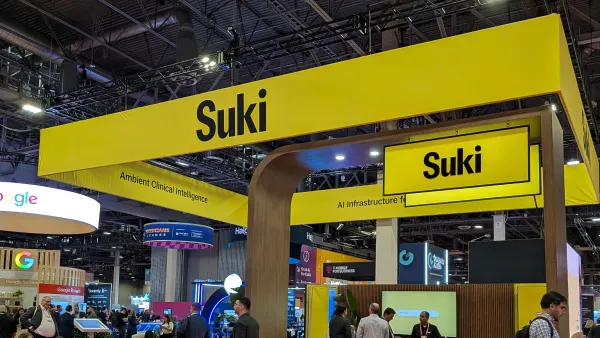
- AI scribe company Suki has launched an agentic operating system aimed at reducing complexity across healthcare’s administrative workflows, moving beyond the company’s initial focus on AI for clinicians.
- The operating system, called Suki OS, serves as a base tech layer that connects healthcare software systems and AI agents across an organization, according to the announcement. Suki also launched two new agent capabilities, one for prior authorization and another for clinical documentation.
- To Punit Singh Soni, Suki’s founder and CEO, it’s a natural evolution for the company, and a reflection of the industry’s shift from point solutions to platforms. “An actual healthcare platform has to be something where ambient documentation is a starting point, not the destination,” he said.
Dive Insight:
Suki is best known for its ambient clinical documentation tool that transcribes doctor-patient interactions. It has also expanded into clinical decision-making support and automated medical coding. Now, the company is taking a wider lens into healthcare workflows beyond clinical care as it seeks to stand out in a competitive market of health AI vendors.
The new operating system is designed to make it easier for healthcare organizations to integrate AI solutions without replacing existing systems, according to the announcement. The company plans to extend its features to health tech partners building on its platform in the future.
“Effectively, Suki OS now adds an agentic layer to the whole Suki product suite, which allows us to finish the last mile of whatever has to be done as a result of that doctor-patient encounter,” Soni said.
With the operating system, Suki touts the system’s ability to support clinicians by preparing patient summaries before appointments, while connected agents verify insurance, facilitate prior authorizations and reduce overall administrative burden throughout an interaction with a patient.
Its two new agents will play a key role in that, according to the announcement, with a pointed focus on advancing prior authorization and revenue cycle workflows.
Suki also launched a framework that ties the success of its product to its own financial viability. In an unconventional move, the company is offering customers their Suki fees back if agreed-upon performance outcomes are not reached.
“I mean, all of the tech that has actually been built over the last 20 odd years in healthcare, can we really look at it and say that it actually has made things better? For the most part, it looks like we have added more complexity,” Soni said.
“The promise of AI has always been that it would be able to stitch all of these things together and make sure that things get done in such a way that actually creates real ROI … We believe that each one of these agents will have a measurable outcome. We want to reinforce the commitment to those measurable outcomes.”
As the health AI vendor market becomes increasingly saturated, companies like Suki are taking action to stand out, from launching platform-based tools to partnering with other vendors to bolster their tech.
Some of Suki’s top competitors, like Abridge and Ambience Healthcare, have also racked up millions in funding and sought to scale beyond ambient scribing.
Partnerships with other vendors are a big part of Suki’s strategy, Soni noted. The company maintains a network of partners that bring different capabilities to the equation. For example, Optum can plug into Suki’s ambient tech to tie clinical data to documentation and coding workflows.
Last month, Suki announced a partnership with Wolters Kluwer’s UpToDate that lets users ask questions to their AI assistant and get answers backed by Wolters Kluwer’s clinical research database.
“Four years ago we were talking about ambient scribes, three years ago it was revenue cycle. Last year and this year we’ve been talking about clinical reasoning. Now we are in operations and agents and stuff like that. In some ways, it is the evolution of the market we are in,” Soni said.
“But I think the competitive intelligence is not going to be having these agents. It's actually having the clinical intelligence, interoperability and infrastructure to make them work across healthcare’s fragmented ecosystem.”