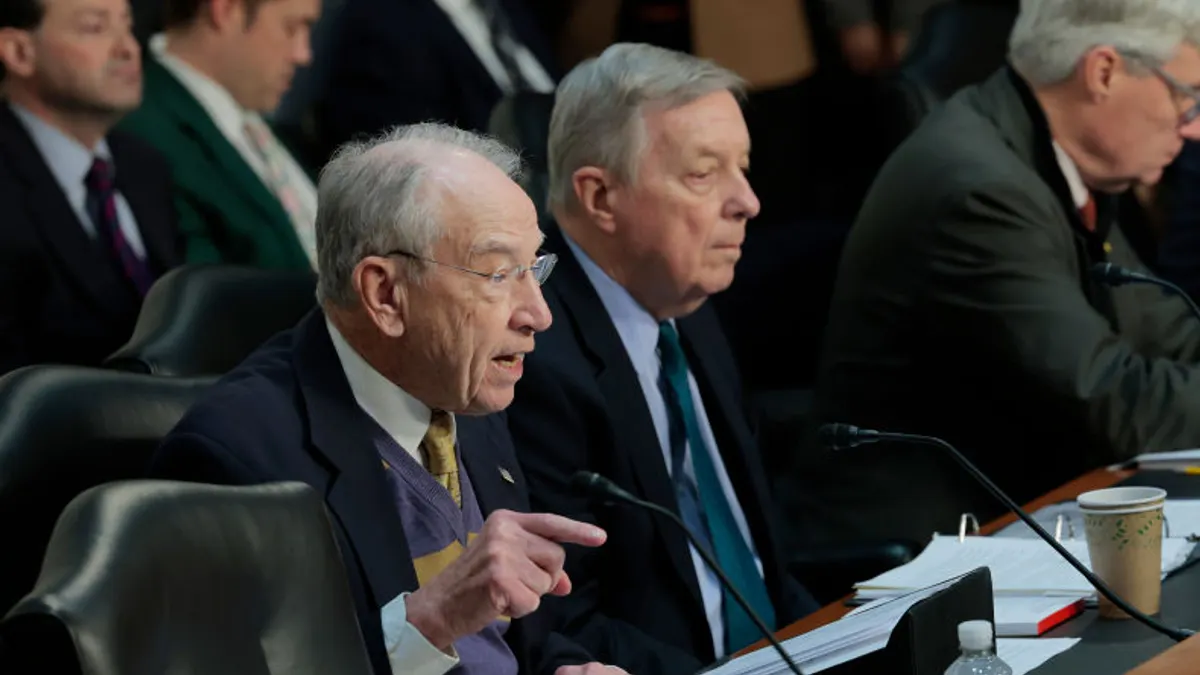


Congress isn’t quite done pointing a finger at drugmakers and pharmacy benefit managers for their roles in the prescription drug affordability crisis. But members of the Senate Judiciary Committee acknowledged on Tuesday the three fingers aimed back at them.
“I am embarrassed that my side has been in control for two years, and we've done nothing. Zero, zilch, nada,” Sen. John Kennedy, R-La., said during the hearing.
Although the Senate committee advanced six bipartisan bills last year aimed at lowering drug costs, only one bill – the Affordable Prescriptions for Patients Act, which would limit how many brand-name biologic patents a drugmaker can use to sue companies making lower-cost biosimilars – made it to the Senate floor.
Judiciary Chairman Chuck Grassley, R-Iowa, said it wasn’t clear why the bills have stalled, although a crowded legislative calendar and strong industry pushback likely contributed.
The lack of reform from the Republican-led Congress comes despite President Donald Trump’s interest in lowering drug prices. Trump launched his own platform earlier this year for people to buy drugs directly from manufacturers at discounted rates similar to Mark Cuban’s Cost Drug Plus Company.
Still, lawmakers at the hearing said addressing exorbitant drug costs remains a bipartisan issue, with both sides of the aisle calling explicitly for legislative action on PBM reform and the stalled bills.
Mending the system, not masking the cracks
Passing the six bills cleared by the committee last year – which tackle patient and regulatory loopholes that have allowed PBMs and drugmakers to maximize profits, as well as PBM self-dealing and vertical integration – should be a priority, industry experts said at the hearing.
The bills work best together as a package rather than piecemeal action, according to Merith Basey, CEO of Patients for Affordable Drugs Now, a patient advocacy and lobbying organization.
“This is why all of these bills must be passed together, because not only do they save taxpayers money, but they will reduce costs for patients, and it will speed those generics to market and biosimilars,” she said during her testimony.
Accessing cheaper generic alternatives has been a major challenge, especially in the U.S. where many approved products face delayed launches or slow market uptake despite the potential to save billions of dollars.
Drug manufacturers can manipulate the market to prevent it from working as intended, Basey said. Companies can make minor modifications to drug patents to maintain their hold on them and delay generics that could lower costs of the drug, she said. This tactic is known as product hopping, but drugmakers can also slow a generic’s market entry by filing dense overlapping patents on a single drug, known as patent thickets.
The bills explicitly seek to ban or restrict drugmakers’ use of these strategies. Another bill also wants to prohibit so-called pay-for-delay agreements in which companies pay or otherwise incentivize generic makers to stall product launches.
How to solve the PBM problem
PBMs didn’t escape the spotlight – nearly all lawmakers and witnesses at the hearing said the drug middlemen were the primary driver of high prescription drug costs in the U.S.
“They have enormous negotiating leverage,” said Dr. Alex Oshmyansky, co-founder and CEO of the Cost Plus Drug Company.
The root of the problem is monopolies in the PBM market, he said, which he claims has kept his company from being able to negotiate directly with some branded and specialty drug manufacturers due to fear of retaliation from larger PBMs.
PBMs work with insurers, drug manufacturers and pharmacies to negotiate discounts and manage prescription benefits. However, critics and researchers have raised concerns that these middlemen have driven up drug prices to maximize their share of the rebates they get for drugs.
The three largest PBMs – CVS Caremark, Express Scripts and OptumRx – are also owned by insurers, which gives the companies significant power over drug manufacturers and pharmacies. PBMs build formularies, or lists of drugs that determine which medications insurers cover, based on negotiations with manufacturers. Less favorable placement could mean millions in lost revenue for drug manufacturers.
“It's like hiring somebody to negotiate the price of a used car for you, but that person also owns the car lot. It's not great,” Oshmyansky stated.
PBM ownership structures also have implications for patients and independent pharmacies, according to Matthew Pitlick, CEO of the Iowa Pharmacy Association. The largest insurers also own their own pharmacy networks and PBMs are incentivized to steer patients toward their own services, limiting access to potentially cheaper options while cushioning the pockets of large companies.
The committee has advanced bills to prompt regulators to investigate patient steering and other anticompetitive behaviors among PBMs. Other lawmakers have introduced bills to break up PBMs entirely as scrutiny grows into the drug middlemen.
Still, the companies may be too big to split, according to Neeraj Sood, senior scholar and professor at the USC Schaeffer Institute for Public Policy & Government Service. Breaking up companies should be a fallback if transparency requirements and other initiatives don’t work first.
“I am a little hesitant to ask these companies to sell off their pharmacies wholesale because I'm worried it might be disruptive for patients if a lot of these pharmacies shut down and patients need to travel longer,” Sood said.
Although Republicans advocated for drug policy reform, some maintained that too much government control in this space could stifle private sector innovation.
“We need these pharmaceutical drugs. The world needs them. They help us live longer, and they improve the quality of our life. It's expensive and very risky to develop these drugs. Only the private sector can do it. If you assign this job to the government, it'll never happen,” Kennedy said.