Dive Brief:
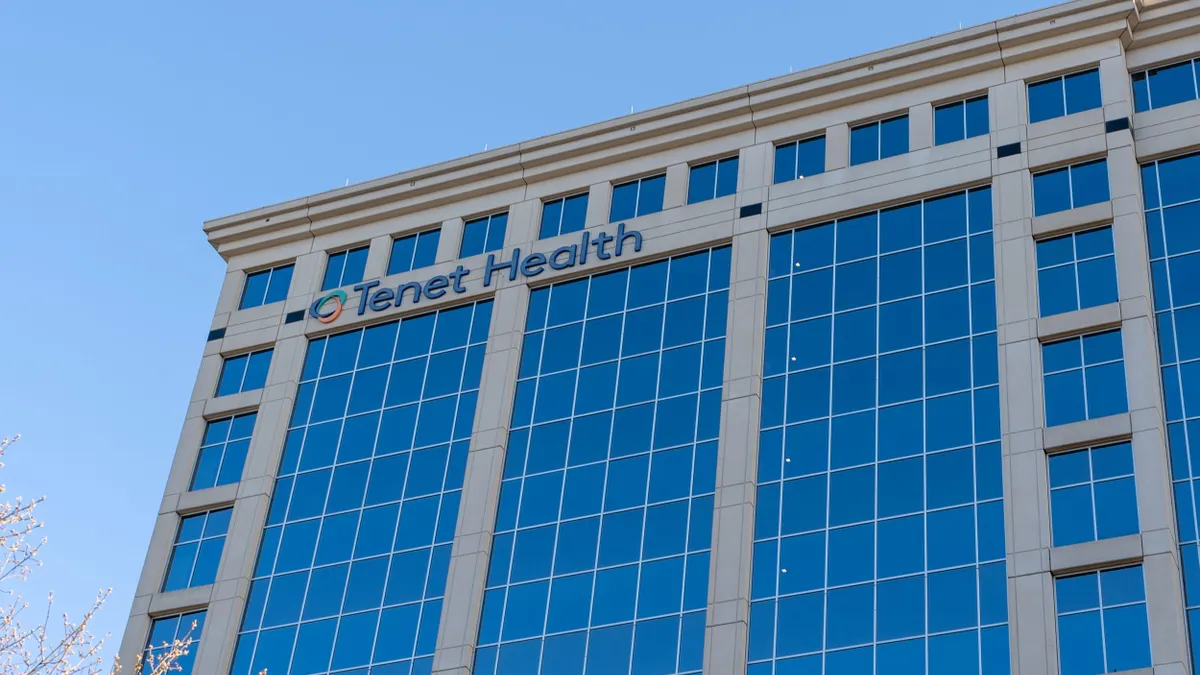
- Tenet Healthcare weathered volume pressures in the first quarter that battered some of its peers as the for-profit hospital operator worked to rein in expenses and focus on more lucrative patient procedures, executives said on a call with investors Thursday.
- A worse-than-expected respiratory season and winter storms in the South caused volumes in its acute care hospital segment to decline by at least 90 basis points compared to the prior year. Same-facility volumes in its outpatient segment dropped 0.3%.
- Still, Tenet posted earnings excluding some non-recurring costs of $1.2 billion in the quarter, higher than Wall Street had expected. Executives said its flexible cost management strategy, in addition to its investments in high-acuity service lines, allowed Tenet to weather the seasonal headwinds.
Dive Insight:
Other for-profit hospital operators have called out the seasonal volume impacts in first-quarter earnings calls this year, an unwelcome development for the companies as they usually rely on strong admissions from viral illnesses to boost their earnings. Community Health Services said the poor volumes contributed to its loss in the quarter, while HCA said the seasonal factors cost it $180 million in adjusted earnings.
Tenet also saw some declines — respiratory admissions dropped 41% compared to the first quarter of 2025 — but executives stressed that it prepared enough in advance to mitigate a larger hit to its finances.
CEO Saum Sutaria said the operator had begun seeing some benefits from its expense management strategy that it detailed last year, including efforts to improve recruiting and retaining staff and control capacity.
In addition to its expense management, the hospital operator’s finances were boosted by outperformance in its ambulatory surgical unit, United Surgical Partners International. Although same-facility admissions were down slightly due to seasonal factors, same-facility revenue grew over 5% year over year.
That growth is due to Tenet’s strategy to focus on lucrative procedure lines, like those in cardiology and orthopedics. USPI recorded double-digit same-store volume growth in total joint replacements in the quarter compared to the prior year, Sutaria said.
Tenet has focused on growing the unit, and has invested half of the $250 million it earmarked for the full year on USPI in the first year alone, including through inking deals to acquire seven ASCs and opening three of its own centers.
Its acute care hospital unit, of which it operates 50 hospitals in eight states, was impacted more heavily by the seasonal volumes, in addition to a lack of Medicaid supplemental payment revenue that it received in the prior-year quarter. Revenue per adjusted admission was down 1.5% compared to the prior-year period.
Revenue in its acute care unit also took a hit from declining patient volumes in the Affordable Care Act exchanges after enhanced subsidies expired at the end of last year.
Hospital operators have begun quantifying the hit to their bottom lines this quarter as volumes begin to decline. CFO Sun Park said revenues in the first quarter decreased between 9% to 10% compared to the prior-year period, following an anticipated 10% decline in exchange admissions during the quarter.
Executives said they still expect to lose $250 million this year due to the subsidy expiry, which Tenet first announced in February.
Tenet posted $702 million in profit on $5.4 billion in revenues during the first quarter. The hospital operator also reaffirmed its guidance, expecting to take in between $21.5 billion and $22.3 billion in revenue for 2026.