Dive Brief:
- Five Democrat governors are asking the Trump administration to delay the Jan. 1 deadline for states to comply with Medicaid work requirements, arguing that shifting guidance from the CMS has made it too difficult for them to implement in time.
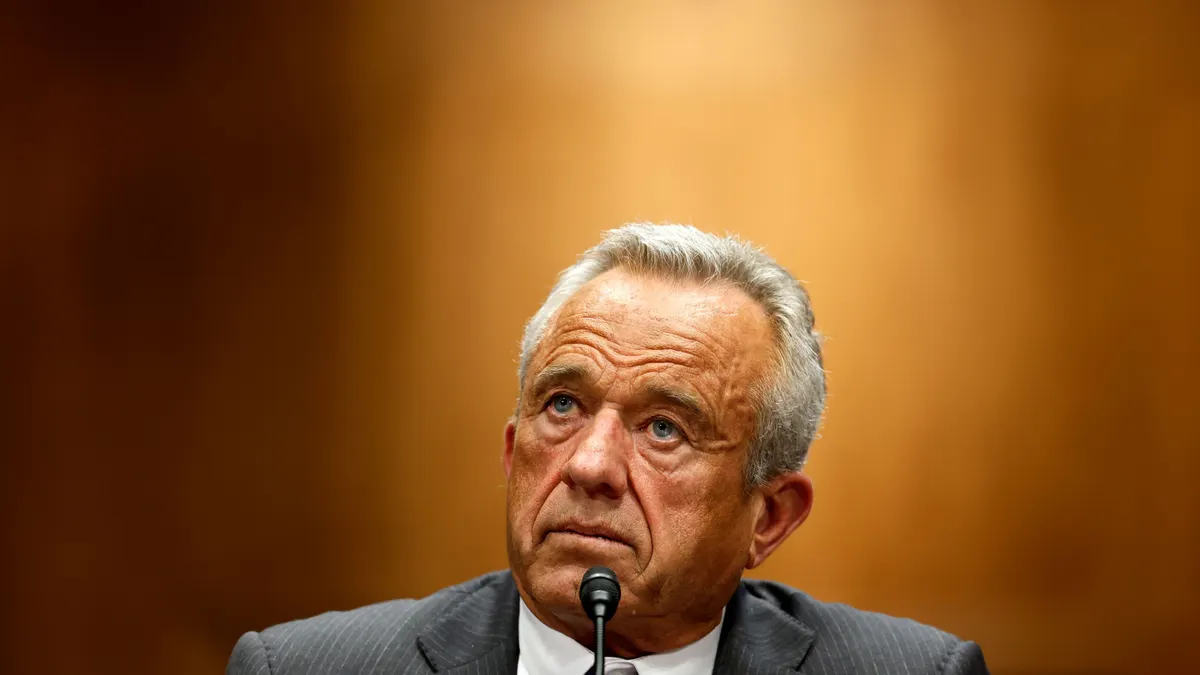
- In a letter sent Thursday to HHS Sec. Robert F. Kennedy Jr., the governors of Oregon, California, Maine, New Mexico and Virginia say they’re worried about people losing access to Medicaid due to administrative barriers created by federal regulators that states weren’t expecting.
- The letter asks Kennedy for a reasonable extension to minimize avoidable disruptions in coverage.
Dive Insight:
It’s Oregon Gov. Tina Kotek’s second try at pushing back work requirements, a first of its kind national mandate tying Medicaid eligibility to beneficiaries’ work, education or volunteering hours that Republicans passed in their massive reconciliation bill last year. The policy, which will kick in at the start of next year, applies to the roughly 21 million people who gained Medicaid eligibility through the Affordable Care Act expansion.
In May, Kotek sent another letter to the HHS asking for more flexibility in implementing the work requirements. The Trump administration never responded, according to Kotek’s office.
Standing up work requirements has been a huge lift for states, which had just 18 months to completely remake their data and eligibility systems, expand outreach and education and track compliance — all with minimal federal funding. Most moved ahead despite a lack of official guidelines from the CMS, relying on informal guidance from federal regulators around issues like which beneficiaries will be exempt from work requirements and how to prove it.
So states say they got an unpleasant surprise in June when the CMS released an interim final rule including significantly less leeway than states had expected. Democrats, clinical groups, patient advocates and other critics argue the guidance is likely to increase the number of eligible Medicaid beneficiaries who improperly lose coverage.
“Given the scope and timing of the changes in the IFR, we do not believe states can meet the January 1, 2027 compliance date in a manner that adequately protects beneficiaries or gives states the opportunity to build and test the systems necessary for successful implementation,” Kotek, along with California Gov. Gavin Newsom, Maine Gov. Janet Mills, New Mexico Gov. Michelle Lujan Grisham, and Virginia Gov. Abrigail Spanberger, wrote.
The IFR included a number of changes that went well beyond what the “Big Beautiful Bill” actually outlined in terms of the severity of work requirements, the governors argued. They cited the creation of stricter rules around how medically frail individuals prove they’re unable to work and unanticipated changes to states’ verification systems, among other policies.
“These are not minor or technical adjustments. They fundamentally change the processes and system logic underlying states’ implementation plans,” the letter reads.
The governors asked the HHS to delay the compliance date and “work with states to establish a realistic implementation timeline.”
The letter adds onto existing pressure on the HHS. More than two dozen states are suing the Trump administration over the rule, though a judge has allowed it to remain in effect as the case moves forward.
Meanwhile, some Republican-led states are enforcing even stricter Medicaid work stipulations than required, eschewing one-year grace periods, asking enrollees to prove their eligibility earlier than needed or racing to get the policy off the ground before the Jan. 1 start date.
Nebraska was the first state to implement work requirements in May. Early data from the state is already showing coverage losses due to red tape. To date, almost 560 new Medicaid applicants subject to work requirements have been denied, with almost 470 of those — or 84% — because they weren’t able to provide the information needed to verify compliance, according to September meeting of Nebraska’s Medicaid advisory committee.
Among people subject to work requirements renewing their Medicaid coverage, about 530 people have been kicked off the program — 92% because they didn’t respond to verification compliance requests.