Dive Brief:
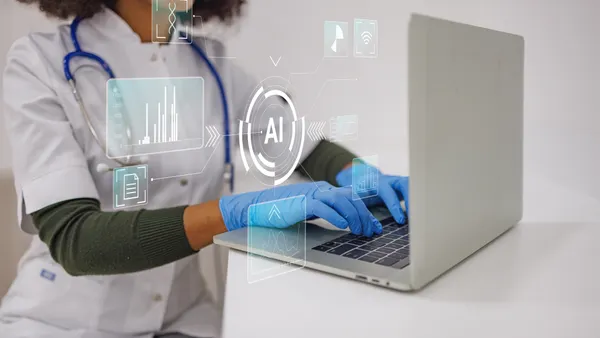
- Artificial intelligence adoption is accelerating rapidly in the healthcare sector, but clinicians are concerned that relying too heavily on the technology could lead them to lose critical thinking and decision-making skills, according to a survey published Tuesday by Wolters Kluwer Health.
- Nearly three-quarters of doctors and 70% of nurses said they used AI at least once a week for work — significantly higher than last year, when 38% of doctors and 46% of nurses reported using the technology. “I think it’s a combination of increased exposure, increased familiarity,” Wolters Kluwer’s Chief Medical Officer Dr. Peter Bonis said. “But really importantly, it’s addressing an unmet need.”
- However, deskilling is a worry for providers. Seventy-four percent of clinicians said losing skills will be one of the greatest AI risks, particularly as clinical decision support tools automate more diagnostic and treatment tasks.
Dive Insight:
AI has become the healthcare sector’s most prominent technology in recent years, igniting hopes the technology could ameliorate workforce shortages and assist with a range of tasks from documenting patient care to analyzing reams of health data.
And providers have moved from experimenting with the technology to using it frequently at work, according to the Wolters Kluwer report, which surveyed more than 350 healthcare professionals and over 250 patients.
For example, 38% of doctors and 32% of nurses reported using AI multiple times per day, up from 10% and 16% last year, respectively. Only 9% of doctors and 18% said they had never used AI tools at work, according to the survey by Wolters Kluwer, which offers its own AI-backed clinical decision support product.
Clinicians are using AI for a variety of tasks. More than half of doctors said they’re using AI to summarize medical literature or analyze data, while 44% reported using AI scribes, which typically record physicians’ conversations with patients and draft clinical notes.
Patients are using the tools too. More than half report using the technology to research medication side effects or find more information about their diagnoses. Around 40% said they’re currently using or would consider adopting AI to simplify medical jargon or interpret test results.
Clinicians adopting AI for a variety of tasks
But despite the increased adoption, providers still have worries about how AI could affect their work. Deskilling linked to AI adoption hasn’t been studied extensively among clinicians, but some research in other fields suggests that relying on the technology could interfere with developing core skills, Bonis said. Users also risk learning tasks incorrectly or losing abilities they already had, he said.
Risks from deskilling among clinicians are compounded by worries about hallucinations, when AI tools make up inaccurate information, according to the report. About three-quarters of clinicians cited hallucinations as a major concern, but 73% said they were somewhat or very confident they could spot incorrect responses.
Still, that leaves about one-quarter of clinicians who aren’t sure they could identify hallucinations. And that could be an undercount, given the challenges associated with catching inaccurate medical information, Bonis said. For example, the AI could hallucinate primary sources or it could cite one accurate study — while missing other papers pointing to a different clinical recommendation, he said.
Many clinicians unaware of AI governance policies
Meanwhile, clinicians are unclear about AI policies and governance at their health systems. Only 27% of doctors and nurses said they knew how their workplace was addressing governance issues.
Among those who knew about their organization’s policies, 63% said they understood how privacy regulations like HIPAA applied to AI use. But just 35% said they knew about guidelines for checking the accuracy and reliability of AI information, and 22% reported their employer had policies describing responsibilities of clinicians and AI products.
“I think this is all in flight. People are wrestling with this. It’s not clear who is going to be responsible for this profound set of issues that can affect the actual delivery of care and who actually takes the risk related to that,” Bonis said. “And so we will be learning about those things as AI becomes increasingly ubiquitous and used in these sort of high stakes domains.”