UPDATE: May 4, 2026: The Supreme Court on Monday morning temporarily paused the 5th Circuit Court of Appeals’ ruling blocking nationwide mail-order access to the abortion pill mifepristone. The order restores abortion providers’ ability to prescribe mifepristone via telehealth and ship the pill to U.S. patients until at least May 11.
Dive Brief:
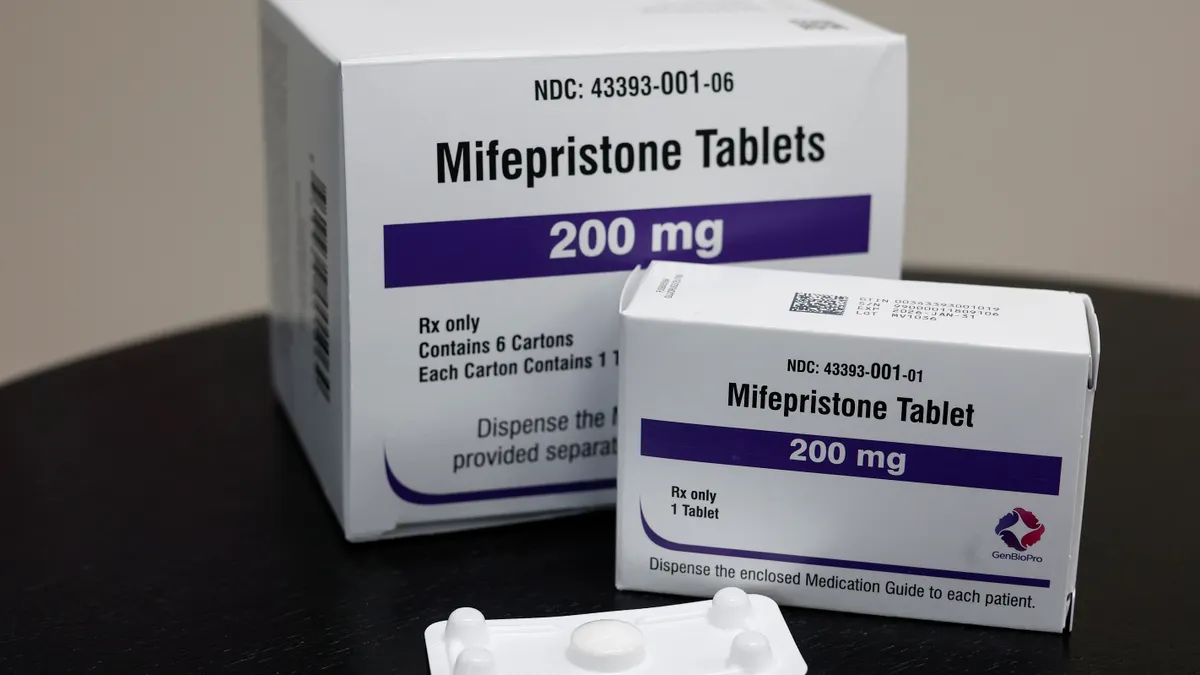
- An appellate court ruling on Friday cut off mail-order access to the widely used abortion pill mifepristone, potentially queuing up a high-stakes legal battle in front of the Supreme Court over Americans’ ability to access abortion drugs outside of an in-person medical visit.
- The 5th Circuit Court of Appeals unanimously ruled that mifepristone must be distributed in person, overruling the Food and Drug Administration’s decision to allow physicians to prescribe the abortion pills via telehealth.
- It’s a major victory for abortion opponents, who had argued that the flow of abortion pills through the U.S. mail system circumvented state bans on the procedure. Two mifepristone manufacturers have already asked the Supreme Court to block the 5th Circuit’s ruling, arguing it creates significant uncertainty for time-sensitive medical decisions.
Dive Insight:
The 5th Circuit’s decision on Friday — which is largely unprecedented, given the rarity of a federal court overruling the scientific determinations of the FDA — looks set to roil the already unstable landscape of abortion access in the U.S.
Currently, 13 states fully ban abortion after the Supreme Court’s highly controversial decision to overturn Roe v. Wade in 2022 ended nearly 50 years of the constitutional right to an abortion in the U.S.
However, the restrictions don’t appear to have impacted the number of abortions being performed. According to the Guttmacher Institute, a reproductive health policy and research group, the abortion rate in 2025 was actually 16% higher than in 2020, the last year of comprehensive national estimates before the Supreme Court returned abortion regulation back to the individual states.
Experts chalk the persistent abortion rate up to patients being able to receive mifepristone over the mail — even in states with rigid bans — after the FDA under President Joe Biden allowed the pills the be obtained outside of a physical doctor’s visit.
Mifepristone is used to end a pregnancy in its early stages, usually in combination with a second drug, misoprostol. Today, more than one in four people in the U.S. who have an abortion do so by getting mifepristone over the mail.
But Louisiana Attorney General Liz Murrill sued the FDA last year, arguing that regulators allowing mifepristone to be dispensed through telemedicine undercut the state’s near-total ban on abortion — one in a number of lawsuits brought by abortion opponents seeking to curtail access to the drug.
The Friday ruling from the 5th Circuit’s three-judge panel reverses the Biden-era flexibility and reinstates a 2021 requirement that mifepristone be prescribed and dispensed in person.
The decision affects all U.S. patients, not just those in states with abortion bans. And despite quick challenges — Danco Laboratories and GenBioPro, two manufacturers of the abortion drug, asked the Supreme Court for an emergency pause on the appeals court’s decision — the ruling will remain in effect while the case works its way through the courts.
It’s unclear how the decision will interact long-term with so-called “shield laws” in Democrat-led states that protect providers issuing mifepristone prescriptions via telehealth, setting up new legal grey areas for providers after years of uncertainty over whether they could be prosecuted for providing abortion care.
But the decision is sure to upend how miscarriage and abortion care are currently delivered, according to experts.
Democrats, patient advocates and reproductive rights groups slammed the ruling, arguing it would create serious reproductive health access issues for U.S. patients, not just those in red states, and impact rural and minority populations hardest.
“The Fifth Circuit’s decision is a dangerous escalation in a coordinated effort to dismantle access to abortion care nationwide,” Kirsten Moore, the director of the EMAA Project, which advocates for increased abortion medication access, said in a statement Friday. “Forcing unnecessary in-person requirements is not grounded in medicine, it’s a political maneuver designed to create barriers and push care out of reach.”
Republican lawmakers praised the 5th Circuit’s decision, heralding it as a victory for unborn life. But the ruling also brings abortion policy back into national spotlight six months before November’s midterm elections, creating fresh political problems for the GOP.
The party is expected to struggle to retain its majority in Congress as the high cost of living and anger over the war with Iran send President Donald Trump’s approval rating plummeting.
Meanwhile, abortion access is widely popular with voters. Two-thirds of U.S. adults oppose banning medication abortion, according to a poll from 2023, while the majority of Americans say abortion should be legal in all or most cases, the Pew Research Center found earlier this year.
“This decision defies clear science and settled law and advances an anti-abortion agenda that is deeply unpopular with the American people,” Julia Kaye, a senior staff attorney for the American Civil Liberties Union’s Reproductive Freedom Project, said in statement Friday.
Access to mifepristone has proved a thorn in the side of the Trump administration. Abortion opponents who helped usher Trump into the White House for a second time have criticized the president for not doing enough to restrict abortion, leading HHS Secretary Robert F. Kennedy Jr. to pledge that the FDA will conduct a full review of the drug’s safety last fall despite decades of data about mifepristone’s safety and efficacy.
Still, the FDA later approved another generic abortion pill, stoking outrage among conservatives.