
Editor’s note: This is the sixth article in a series of stories profiling medtech companies that are changing the field of robotic surgery. Read the other profiles here.
More surgical procedures in the U.S. are migrating to ambulatory surgery centers, where costs are lower, patients go home the same day, and physicians often have an ownership stake.
Hospital systems are prioritizing investments in ASCs as well, eager to expand outpatient capacity and stay competitive. Yet despite their growing popularity, and advances in medical technology that have allowed a wider range of procedures to be performed in ASCs, most do not have a soft tissue surgical robot.
Distalmotion, a Swiss company whose robot is cleared in the U.S. to perform several common same-day procedures, is working to change that. ASCs that want to add a robotics program face barriers such as space limitations and the expense of acquiring and maintaining a traditional robotic platform.
“We solve a lot of those problems,” said Distalmotion CEO Greg Roche.
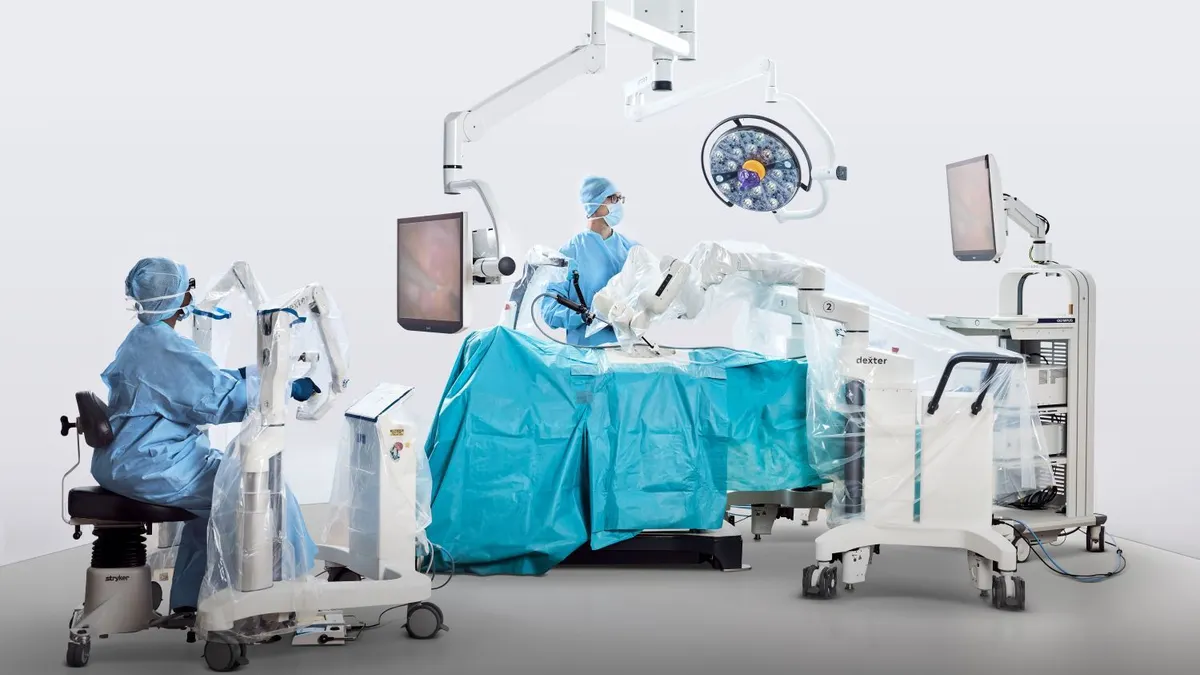
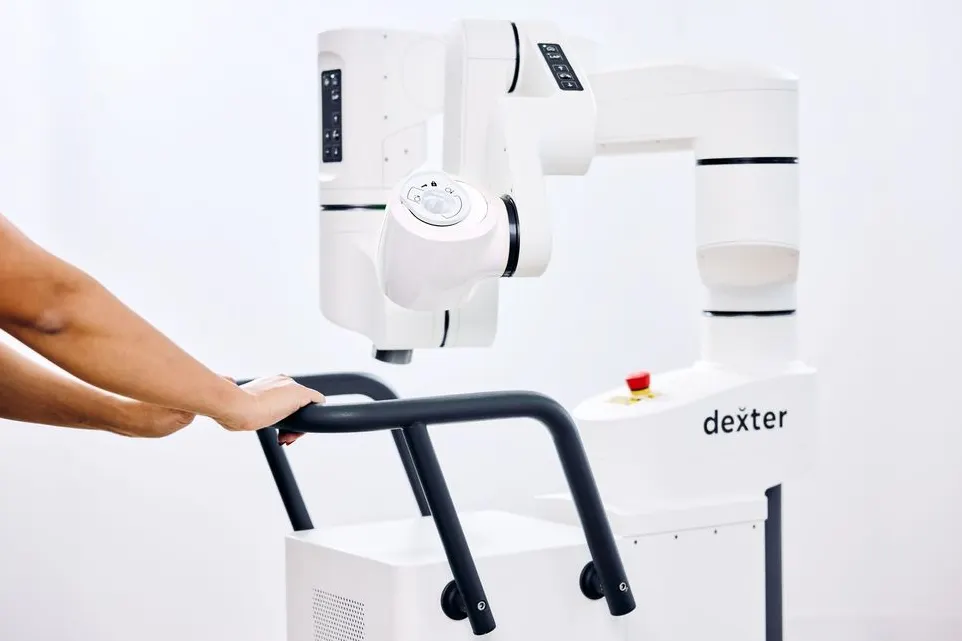
The company has designed its Dexter robot to provide the clinical benefits of robotic surgery — namely, the dexterity of “wristed” instruments that mimic the human hand but with greater predictability — in a system that more care providers can afford to own. With most general and gynecologic surgeons now trained on robots during their residency and fellowship programs, integrating a robotic system into the workflow “is no longer a luxury” for a provider, said Roche. “It’s a required tool.”
A spinoff from the Swiss Federal Institute of Technology in Lausanne, Switzerland, Distalmotion received Europe’s CE mark in 2020 for use of its robot in urology, gynecology and general surgery.
In the U.S., the robot gained Food and Drug Administration de novo authorization for inguinal hernia repair in 2024, followed last year by clearances for gallbladder removal and hysterectomy. The company has submitted a request for additional gynecological indications. Next up is a filing for ventral hernia repair, said Roche. The generally low-risk procedures are increasingly moving to ASCs.
“We believe that the cost profile of our robot allows for profitability within these lower-acuity, high-volume surgeries,” Roche said. “What we're trying to accomplish is to really drive these surgeries into the ASC.”
To further its U.S. expansion, Distalmotion last year raised $150 million in a Series G funding round. Johnson & Johnson’s JJDC venture capital arm is a strategic investor. In all, the company has received about $400 million from its backers, according to Roche.

Now, as its robot rolls out in the U.S., the ASC-focused strategy is fueling momentum. After surpassing 3,000 cumulative procedures across Europe and the U.S. in the fourth quarter, Distalmotion’s first quarter was its best yet, Roche said.
“We're being very pragmatic and really picking a sector that we think needs a lot of help,” said Roche. “We fit a need. We’re solving a problem for hospital and physician partners and for patients.”
Cypress Surgery Center in Wichita, Kansas, acquired its first surgical robot, a Dexter system, in March. The ASC was eager to add a robot and had looked at Intuitive Surgical’s da Vinci system in the past but found it too costly. Da Vinci was also too bulky for the center’s operating rooms, explained Cynthia Meaux, market CEO at Cypress parent Surgery Partners.
“Dexter comes around and all of a sudden offers a proposition that is a smaller footprint,” said Meaux. “Our ORs at Cypress are smaller. They are a lot smaller. Fitting a da Vinci is a bit more cumbersome than the Dexter robot. I mean, we just wheel the bad boy around.”
Meaux said having the robot gives the center a competitive advantage in the local marketplace. Distalmotion provided surgeon training and support, helping to make the program feasible. “You have surgeons who know how to use a da Vinci but are willing to toggle between two different robot systems now,” she said.
The number of Medicare-certified ASCs has been climbing steadily, at an average annual rate of 2.2% over five years, to reach more than 6,400 facilities in 2024, a report last month from the Medicare Payment Advisory Commission, or MedPAC, shows. In contrast, slightly more hospitals closed than opened over a 14-year period through 2023 tracked by health policy researcher KFF.
Advances in minimally invasive surgery have supported a shift in many procedures to ASCs, from cataract removal and colonoscopies to hip and knee replacements. Patients like the convenience and lower out-of-pocket costs, compared to hospital outpatient departments, while physician owners have more control over their work environment and can earn additional income, MedPAC said.
“We're being very pragmatic and really picking a sector that we think needs a lot of help. We fit a need. We’re solving a problem for hospital and physician partners and for patients.”

Greg Roche
CEO of Distalmotion
Distalmotion is not the only robotics company pursuing the ASC market. Industry leader Intuitive, which has acknowledged that some customers are more sensitive to capital acquisition costs, last year began selling a refurbished version of its older-model da Vinci Xi system.
Intuitive placed 42 refurbished XiR systems with customers in 2025, and 34 more in the first quarter of 2026. The strategy gives Intuitive a sizable long-term opportunity to expand access to the da Vinci platform in both ASCs and international markets, CEO Dave Rosa said on a January earnings call.
More recent contenders in robotic surgery, including CMR Surgical and Moon Surgical, are also targeting ASCs.
Roche maintains that Distalmotion has a combination of advantages that give it an edge over the competition. The former Zimmer Biomet robotics executive, who joined Distalmotion in 2023 after leading German robot developer Avateramedical, said Dexter is designed specifically for the ASC environment, and it's unlikely that any one competitor can match all of its attributes. For starters, he said, the robot requires just 125 square feet to operate and can be moved through a standard door frame, plugged into a standard outlet and set up in four minutes or less.
Unlike Intuitive’s da Vinci, Dexter’s console positions the surgeon in the sterile field with the patient, making it possible to switch between robotic and laparoscopic techniques during a procedure.
The platform is also open architecture, meaning customers can use the visualization, stapling, advanced energy and other technologies that they choose. The system’s single-use instruments require no sterilization, another big plus for ASCs, which often do not have the capacity to process robotic instruments, Roche said.
“With the Dexter, we didn't have to change any of those surrounding complementary services,” said Surgery Partners’ Meaux. “It fit into our system. It fits our instrumentation, our videos, our scopes. So the open system is important, because it didn't require that much more incremental investment into single-branded things like you do with a da Vinci.”
Distalmotion is working on other ways to improve efficiency in the ASC, such as a “flip room” concept to facilitate sharing between operating rooms. Because one room may be used for many types of procedures, a robot must be movable between cases, said Roche, but with most traditional platforms, that is hard to do.
“If you are in an ASC, you cannot have a room beholden to a robot,” he said.
Another project is called solo robotics. “We believe we're going to get to a point where a surgeon can do certain procedures by himself, so not even a nurse is in the field,” said Roche.
The CEO predicted that in the future, the robotic surgery market will be segmented, with some companies specializing in platforms suited for the outpatient setting, like Distalmotion, and others battling for a space in the hospital itself, where complex procedures will continue to be performed.
“We could have built a closed-system robot with all the feature sets and all the bells and whistles. We chose not to do that intentionally,” said Roche. “We’ve chosen to say no to a lot.”