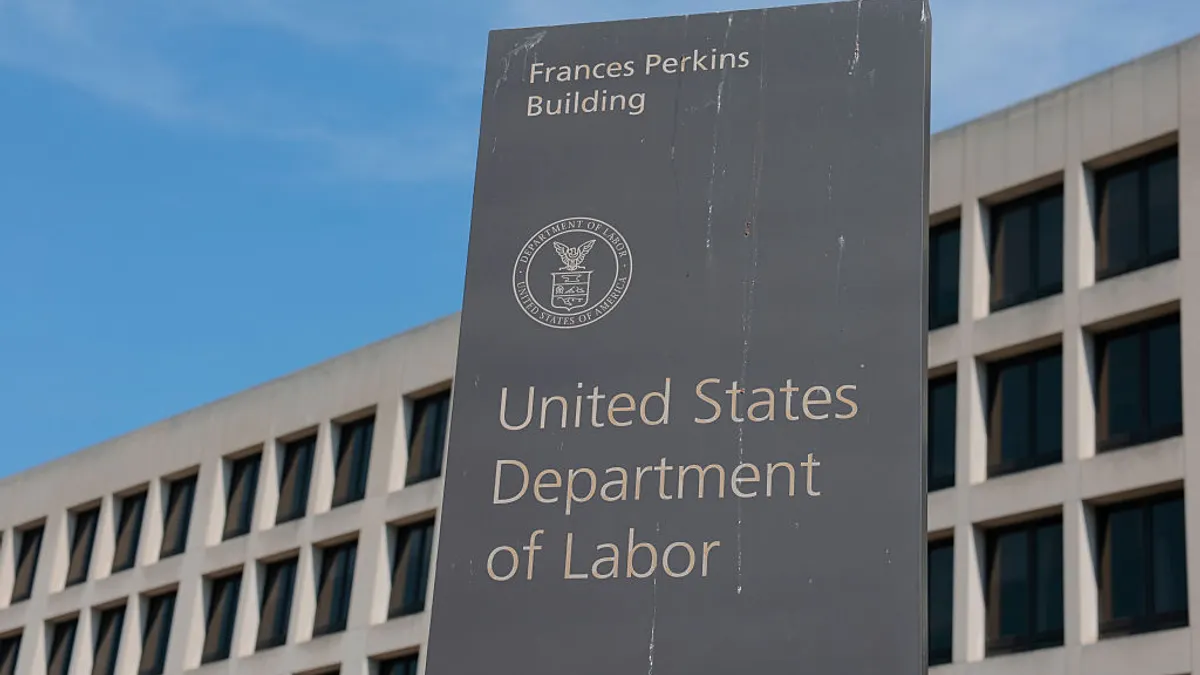
Employers, lawmakers, patient advocates, price transparency groups and more urged the Department of Labor to quickly finalize a rule that would force pharmacy benefit managers, shadowy middlemen in the drug supply chain, to share more pricing and compensation information.
PBMs did not feel the same, according to industry comments on the proposed regulation.
The rule has been caught up between two powerful industries — healthcare purchasers like employers and the PBMs they contract with to manage their drug benefits — since it was proposed in January, amid growing criticism of PBMs and a broader bet from the Trump administration that better price transparency will lower healthcare costs.
The public input period on the rule closed Wednesday. In comments, PBMs slammed the rule as unnecessary government overreach, especially in light of recent industry efforts to improve transparency and simplify their business practices.
Still, many of the hundreds of comments urged the DOL to go even further, and strong-arm more types of drug middlemen into sharing even more rigorous information.
PBMs, the biggest of which are owned by healthcare conglomerates, have been successful at avoiding significant federal reform to date, despite some piecemeal efforts from Congress. However, the DOL’s rule — and the broad support it’s receiving from varied healthcare stakeholders — suggests the industry’s concerns about negative attention from Washington won’t ease any time soon.
Drumbeat of support for better PBM transparency
PBMs sit at the epicenter of the U.S. pharmaceutical supply chain, organizing pharmacy networks, negotiating savings on drugs with pharmaceutical companies, creating prescription formularies and processing claims for employers and health plans.
As such, the companies are in a powerful position to influence which patients receive which drugs when — and at what cost.
PBMs argue they save their clients significant money. But criticism of the middlemen has been growing, especially as millions of Americans struggle to afford prescription drugs. Employers and insurers complain that it’s difficult to know if their drug dollars are spent wisely or squirreled away by PBMs as profit, given the complexity of their contracts and compensation arrangements.
The DOL proposed its PBM transparency rule in January with the goal of lifting the curtain.
The rule would require PBMs to disclose detailed information about their compensation, including rebates negotiated with drugmakers, any profits from spread pricing arrangements and any additional payments recouped from pharmacies related to an employers’ prescription drugs.
PBMs would have to share actual dollar amounts with their clients, not just percentages or other less-exact information. (PBMs often disclose vague formulary or methodological details to their clients, instead of precise dollar figures.)
If the rule is finalized, employers and plans will get that information both before they sign a contract with a PBM, and in semiannual reports. Employers and plans will also have the right to audit disclosures to ensure they’re accurate.
The DOL heralded the rule as a game-changer. Many of the roughly 560 comments that the department received on the rule agreed.
The proposal is “an important step toward exposing the opaque pricing practices that have driven up prescription drug costs for employers and workers,” Taylor Hittle, the executive director of employer coalition the Partnership for Employer-Sponsored Coverage, said in a statement.
Still, regulators could go further to address gaps in the proposal, commenters said.
For example, PBMs would be forced to disclose rebates they receive from drugmakers and group purchasing organizations, middlemen that aggregate different employers’ and health plans’ members to increase leverage in negotiations with drugmakers. But GPOs might not be passing all rebates through to the PBM in the first place — especially since major GPOs are all subsidiaries of the “Big Three” PBMs owned by Cigna, CVS and UnitedHealth, so their parent companies get to keep rebate dollars either way.
In addition, the proposed rule only applies to self-insured group health plans, wherein employers directly assume the financial risk of providing healthcare benefits. It would not apply to fully insured group plans, in which PBM services are bundled with insurance.
The DOL should clarify that the disclosure requirements apply to all PBM-controlled entities, the PESC wrote in its comment letter. Regulators should also apply the transparency framework to fully insured group health plans.
“Excluding fully insured group coverage would leave a substantial portion of the employer market without the transparency necessary to evaluate whether PBM-driven costs are reasonable. Employers purchasing insured products should not be forced to accept blind pricing in one segment of the market while more meaningful transparency is required in another,” the PESC argued.
Other comment letters from top Democrat congressmen, cancer providers, state financial officers, patient advocates, price transparency groups and even law enforcement officers echoed that the DOL needs to include all PBM-affiliated groups, including GPOs, along with fully-insured plans in its rule.
Regulators should also consider expanding disclosure requirements to other middlemen in the pharmaceutical supply chain, like third-party administrators and claims repricers, multiple commenters wrote.
PBMs push back
Calls for the DOL to expand the scope of the rule stand in direct contrast to what PBMs want from regulators.
The Pharmaceutical Care Management Association, the largest PBM lobby, called on the DOL to withdraw the rule entirely.
The DOL doesn’t have the legal authority to strong-arm PBMs into more pricing disclosures, the PCMA argued. PBMs are already responding to client and regulator calls for more transparency, so the rule is unnecessary. Moreover, it risks degrading competition in the pharmacy benefits market, by putting more administrative burden — some of it duplicative with other PBM compensation disclosure requirements — on small PBMs, the group said.
“The dozens of smaller PBMs in America simply cannot sustain the regulatory environment the DOL rule would create,” the PCMA wrote in its comment letter.
This argument could hold water with the Trump administration, which has hustled to roll back government restrictions on the private sector. It’s also common for companies to lobby against transparency requirements by saying they’ll harm competition by forcing the disclosure of proprietary information.
The rule does also overlap with existing PBM disclosure rules. Amid growing bipartisan scrutiny of the drug middlemen, Congress passed PBM reforms in legislation to fund the government earlier this year, including increased transparency and oversight of PBM services for Medicare prescription drug and employer health plans.
After the law, called the Consolidated Appropriations Act of 2026, passed in early February, the DOL extended the comment period for its rule and requested input on how the proposal might overlap with the new transparency framework.
In public appearances, DOL officials have argued the rule operationalizes the CAA.
“The new legislation tells PBMs what they must do. Our rule spells out how you, the plan fiduciary, get the details you need to make sure they follow through,” Caitlin Soto, the health policy lead for the DOL’s Employee Benefits Security Administration, said during an event in Washington, D.C., last month, hosted by employer group the Purchaser Business Group on Health.
“Put simply, the law sets strong new standards across the board, and our rule gives you the practical, everyday tools to enforce them,” Soto added.
But some of the CAA’s provisions are “blatantly redundant” with the DOL’s proposed rule, which would result in fragmented and potentially conflicting reporting requirements, the PCMA argued.
Other commenters, including those in support of the rule broadly, agreed that the DOL should consider better aligning the rule’s stipulations with those in the CAA.
But, “in doing so, the Department should not accommodate industry requests to withdraw, weaken, or otherwise undermine the Proposed Rule,” Reps. Bobby Scott, D-Va., and Mark DeSaulnier, D-Calif., wrote in a comment letter on the proposal.
The DOL’s rule is “substantially different from, and in certain ways stronger than” the CAA’s reporting obligations,” the lawmakers, both of whom hold leadership positions in the House Committee on Education and Workforce, wrote. They urged the DOL to quickly finalize the rule.
A bipartisan coalition of 45 attorneys general also asked the DOL to make sure that PBMs can’t sidestep transparency reforms by blaming existing law. The attorneys general said they would be happy to help the federal government enforce the rule if needed.
All 50 states have enacted laws reining in PBMs amid a lack of comprehensive reform from Congress. Still, momentum is rising on the Hill to address some of the middlemen’s more controverisal business practices as Americans ratchet up pressure on their representatives to improve healthcare affordability.
That pressure is also being felt by the White House, especially in advance of November’s midterm elections.
The DOL’s proposed rule is part of the Trump administration’s broader focus on price transparency, and follows an executive order last spring directing the department to improve employers’ transparency into PBM compensation.
Experts generally agree that more transparency could help, mostly by encouraging PBMs to compete more aggressively against each other, which could reduce excessive profits.
Still, transparency is not a silver bullet, especially given the state of the market. The “Big Three” PBMs —Cigna’s Express Scripts, CVS’ Caremark and UnitedHealth’s Optum Rx — jointly control about 80% of all U.S. prescriptions, fueling calls for Congress to consider breaking them up.