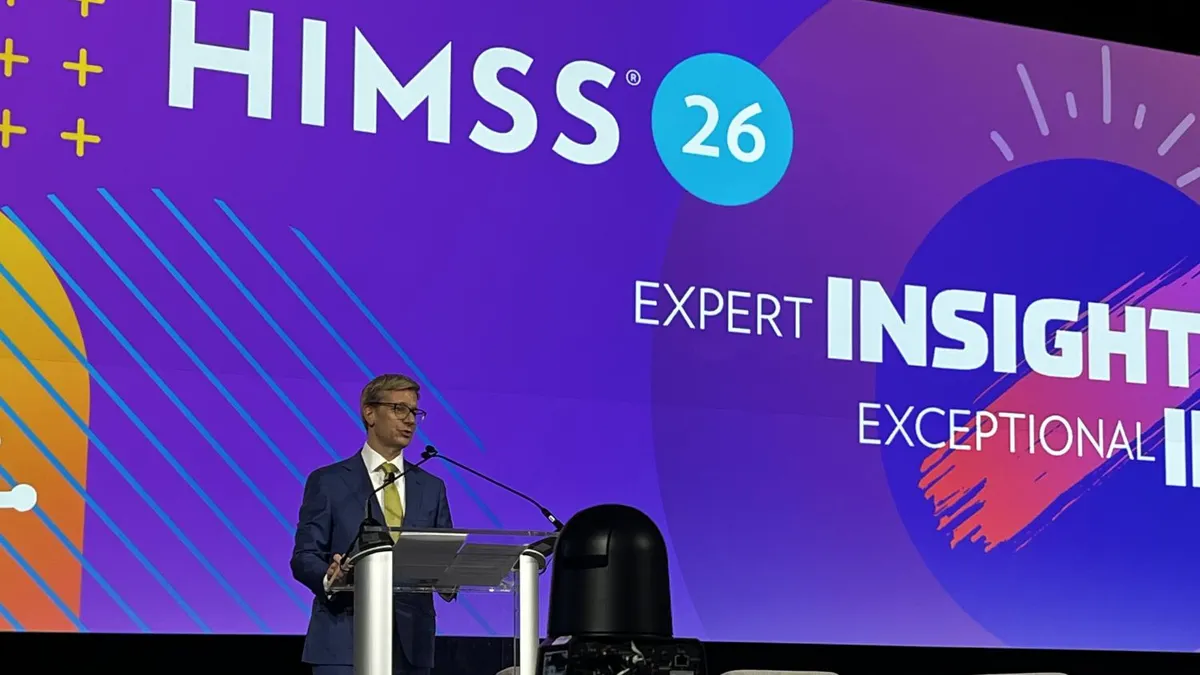
LAS VEGAS — Adopting artificial intelligence tools could be a boon for safety-net health organizations, which frequently operate at low margins with fewer resources — and face more turmoil as significant Medicaid cuts loom, experts said at the HIMSS conference Wednesday.
Implementing the technology is more challenging for the providers, which serve low-income populations and offer care regardless of patients’ ability to pay, given their workforce challenges and sometimes limited technical capabilities.
Now, safety-net organizations will face new headwinds. Last summer, President Donald Trump signed sweeping tax and policy legislation into law that includes significant funding reductions to the insurance program Medicaid.
The “Big Beautiful Bill” will likely cull millions of people from coverage and cut billions from state Medicaid programs.
“[The law] presents an existential crisis to safety net providers,” Kara Carter, senior vice president of strategy and programs at the nonprofit California Health Care Foundation, said during a panel Wednesday. “There’s no question about it. That is red states, blue states, purple states. It does not matter.”
However, the challenges brought on by the policies could be an opportunity for safety-net organizations to take advantage of AI to ameliorate some of the damage, experts said.
In one of the law’s most significant impacts, many Medicaid beneficiaries will need to log 80 hours of work, school or volunteer hours per month to stay enrolled in the safety-net insurance program.
That will likely create a lot of administrative work for enrollees and Medicaid programs. For example, before Arkansas’ work requirement policy was struck down during the first Trump administration, many beneficiaries didn’t know about the requirements and struggled to report their compliance.
Additionally, the law passed last year requires states to check enrollees’ eligibility every six months instead of annually.
AI could help with redeterminations and enrollment calls, Carter said. Some AI agents can handle outreach at the rate of 40 to 100 calls a second, she added.
Many of the law’s provisions don’t go into effect immediately, giving states and providers some time to prepare, said David Ford, CEO of CMA Physician Services, the practice transformation subsidiary of the California Medical Association.
“Before state legislatures start doing the really awful, terrible things we know they’re going to do — kicking people off the program, limiting benefits — the hope is that AI can generate some efficiencies and give us some savings and allow us to maintain some of that, even in a resource-strapped environment,” he said.
Plus, the Rural Health Transformation Program — a $50 billion fund included in the law to improve care in rural communities — could give some states a lot of money to adopt AI and other technologies, said Adimika Meadows Arthur, executive director of the nonprofit Health Tech 4 Medicaid.
AI might be able to fill some gaps among providers too. If clinics need to cut back on staff, they’ll still need to make calls to patients — and AI could be one option to help, said Dr. Jeffrey Arroyo, associate director of clinical informatics at AltaMed Health Services, the nation’s largest federally qualified health center.
“We’re already short staffed, but we’re probably going to lose more,” he said. “That doesn’t mean the work is going to go away. So it’s going to be put more on IT to take advantage of these AI solutions that are seen outside of healthcare and make magic happen.”