
At its best, artificial intelligence in healthcare helps augment humans’ capabilities. Whether you’re a physician, nurse or radiologist, AI has the potential to help increase efficiency, delivering value to clinicians, patients and the entire healthcare organization. At its worst, AI can be a distraction that costs time and money. Too often, that’s the case when an organization adopts the wrong tools. According to a survey published in the Journal of the American Medical Informatics Association, 77% of health systems identified immature AI tools as a significant barrier to adoption.
As the technology continues to rapidly evolve, the right solution can help healthcare leaders keep pace. “You need to partner with an organization that not only has the right platform, but one that helps you understand the value of AI, how to utilize it, and helps your staff understand the technology and adjust to the changes it brings to the organization,” said Riz Pasha, M.D., chief medical information officer with Microsoft.
The right partner, Pasha added, can help organizations identify capabilities that add value versus tools that create barriers. And in such a fast-moving field, those insights can make a lasting impact.
Looking ahead, Pasha shared four AI capabilities that he said he believed healthcare leaders should prioritize in 2026.
- AI clinical assistants, and agents, that will help power workflows. AI clinical assistants help clinicians with tasks; AI agents autonomously run multistep clinical or operational workflows. Together, they emerge as the natural evolution of today’s AI scribes and assistants. While scribes focus on documentation and assistants support basic tasks, agents orchestrate broader workflows by taking on more complex, multistep actions. These tools have become more capable, expanding value beyond documentation — helping clinicians answer questions, perform calculations and even improve revenue-cycle accuracy. “The AI supporting your notetaking today can help identify the most specific diagnosis or appropriate code based on what it hears,” Pasha explained. For example, if the solution knows a patient has renal failure and hears a clinician discuss diabetes, it can infer “diabetes mellitus with nephropathy,” leading to more precise documentation and better care.
- Teams of agents that collaborate. In the near future, Pasha said, healthcare teams might work with multiple assistants, or agents, that collaborate behind the scenes to streamline care. Instead of depending on a single assistant to handle many tasks, you might employ several specialized agents that coordinate to deliver the right support at the right moment. “Clinicians will have access to multiagentic workflows, where each agent masters a specific function,” Pasha explained. One agent might focus on gathering health information from different sources, another on generating differential diagnoses, and a third could oversee and coordinate the other agents. The result, he said, would be greater clinician empowerment and more effective care delivery.
- A data platform that safely and effectively connects multiple data sources. Most organizations operate among silos of data. Some may sit in the EHR, or across multiple EHRs, while other information lives in proprietary and third-party sources, research databases, and other locations. To make the most of the agents and their workflows, it’s essential that healthcare organizations use a platform that can tap into available data sources. “You don’t get the full benefit of agents until you connect them,” he said. “Your platform should act as connective tissue for the clinical workspace, enabling your team to access many different tools while also following responsible AI principles as well as appropriate change-management procedures and protocols.”
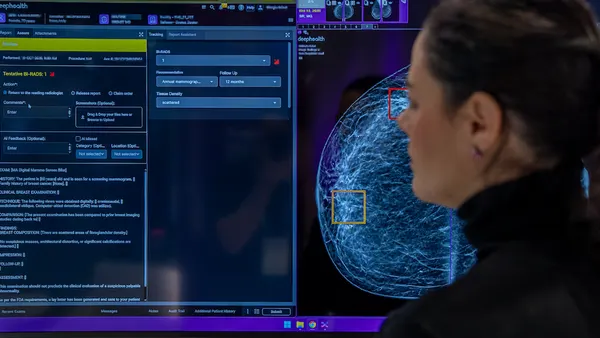
- The ability to plug in apps and agents from third-party developers. As AI continues to advance, accessing agents developed by third parties is essential for clinicians, and Pasha said it was important that your organization’s AI technology supported and integrated those abilities into one workflow. “Companies developing these agents have their own expertise, and that’s something that healthcare organizations need to be able to tap into, versus developing their own agent from scratch,” Pasha said. A clinical assistant, such as Microsoft’s Dragon Copilot, enables physicians, nurses, radiologists and other clinicians to easily and safely access trusted third-party apps and agents, he added, which brings value and scalability in patient care and diagnostics.
Advancements in AI aren’t slowing down. That’s why it’s critical for healthcare systems to find the right partner today so they can seamlessly access the tools they need and pave the way for advancements to come. “You need to be using a solution where apps and agents can be easily added to keep up with the pace of innovation,” Pasha said.
In the not-so-distant future, Pasha added, AI agents will continue carrying out an even more immersive role in healthcare. He envisions an exam room where the agents can recognize a provider and perform tasks related to the conversation between the provider and the patient. “Imagine you walk into a room, and it recognizes you from proximity badges or facial analysis, or it recognizes your voice. While you’re talking to the patient, and saying something like, ‘We should review your CAT scan,’ it’s surfacing information for the clinician and the patient to look at together. So you have this assistant that is listening to you, understanding what’s happening, and while it’s recording, it’s also processing that information in real time, and driving clinical decision support and driving workflow.” As a result, he said, healthcare teams will be freed up to devote their attention to the most human of tasks, which is often what drew them to medicine in the first place.
“When healthcare organizations run on a unified and secure foundation, like Microsoft’s, the agents can perform a lot of the time-consuming work to gather the available data, and then they can use the guidelines or protocols to suggest a light workflow for the clinicians,” Pasha said. “When that happens, clinicians are better able to focus their attention and expertise where it’s needed: the patient.”