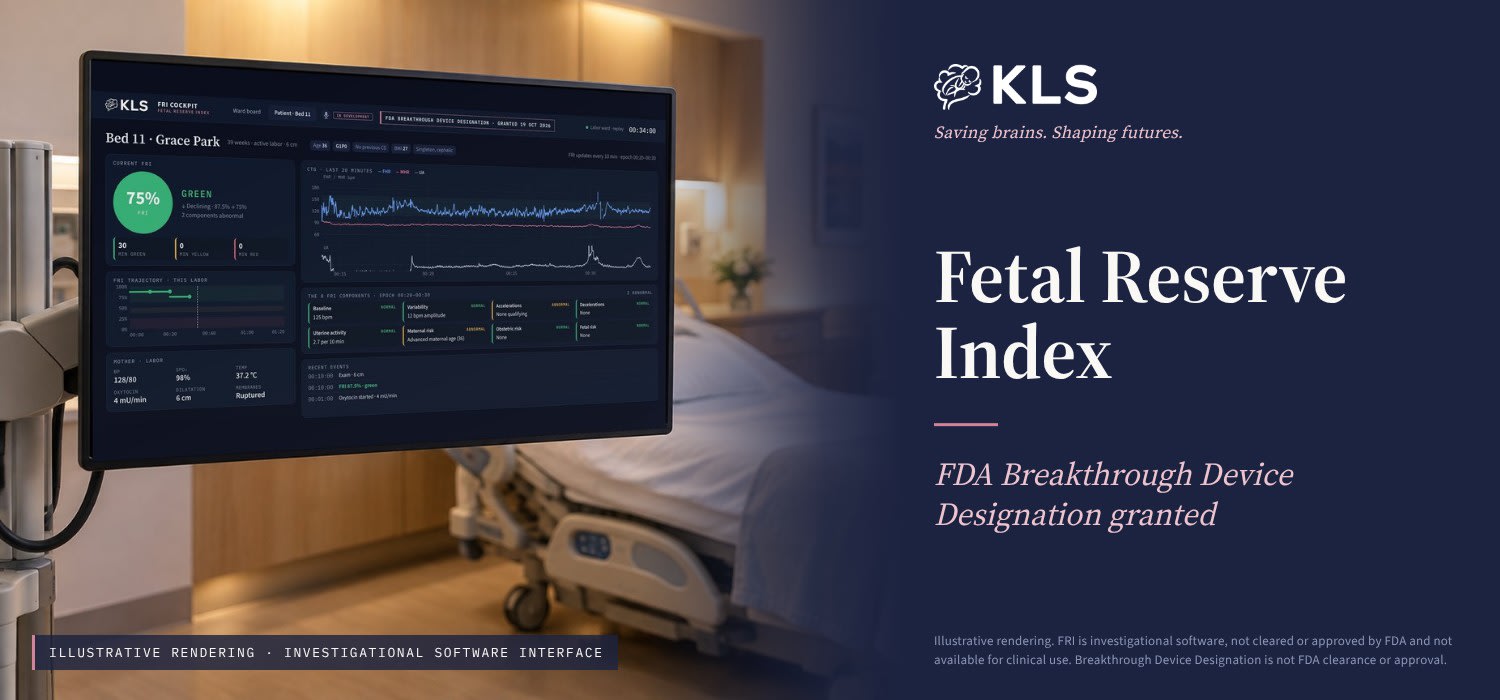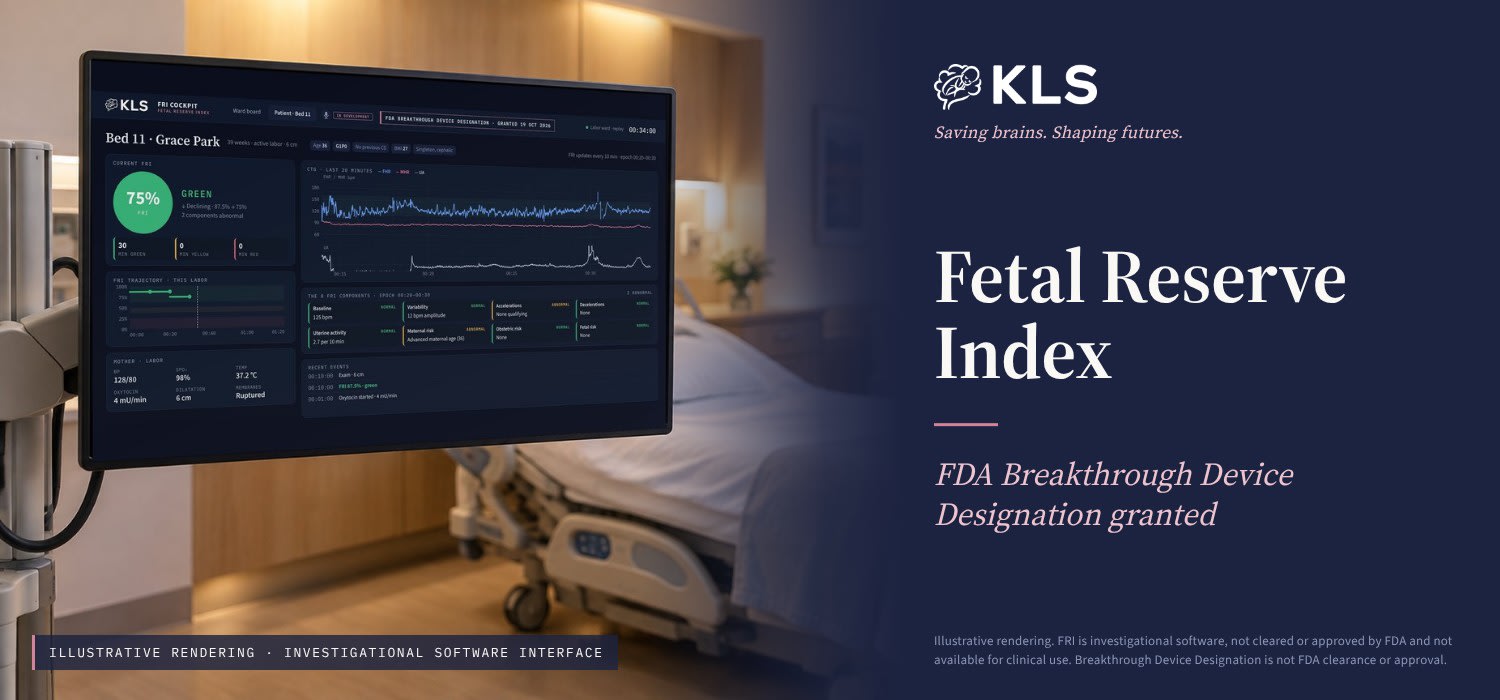
For half a century, the most consequential decisions in childbirth have rested on a wavering line. The fetal heart-rate tracing can tell a labor team that something may be wrong. It rarely tells them how much time the baby has.
Keeping Labor Safe (KLS) believes the answer can be found in information the delivery room already collects. The company today announced that the U.S. Food and Drug Administration has granted Breakthrough Device Designation to the KLS Fetal Reserve Index (FRI), investigational clinical decision-support software designed to combine the signals from standard fetal monitors with the risk profile of each mother and baby, and to estimate how much physiological reserve a fetus has left during labor. FDA's Center for Devices and Radiological Health issued the designation on Oct. 19, 2026.
FDA reserves Breakthrough Device Designation for devices that may provide more effective diagnosis or treatment of life-threatening or irreversibly debilitating conditions. The designation provides opportunities for closer engagement with the agency during development and priority review of future submissions.
A decision with two ways to go wrong
Every labor ward lives with the same dilemma. Act too late, and a baby can be injured for life. Act too early, and a mother may have a cesarean she did not need. Clinicians make these calls in real time, often from tracings that experienced specialists interpret differently.
Reading the trace in context
Conventional interpretation classifies a heart-rate pattern as it appears. The FRI asks a different question: given this mother, this baby and this labor, how much reserve remains, and how fast is it being used? The software weighs the tracing and contractions against maternal, fetal and obstetric risk factors, recalculates as labor progresses, and expresses the result as a single percentage designed to give the whole care team a shared view of risk. Each reading is time-stamped, building a continuous record of how that risk evolves.
The FRI is software-first. It is designed to run on the fetal monitors hospitals already own, with no new sensors or hardware.
Decades of Clinical Insight, Backed by Science and Intellectual Property
The FRI was developed by Prof. Mark I. Evans, MD, KLS co-founder and chief medical officer, an obstetrician, geneticist and fetal medicine expert at the Icahn School of Medicine at Mount Sinai. The method is described in 19 peer-reviewed journal articles and a 2025 Cambridge University Press book, and is protected by 35 issued patents and design registrations across five families in the U.S., Europe, China, Japan, Israel and Brazil.
"Every obstetrician knows the moment: a tracing that isn't reassuring, a labor that isn't finished, and a decision that can't wait," Evans said. “A heart-rate pattern on its own can't tell you how much reserve a baby has left. The FRI is designed to place the tracing in the context of the risks carried by this mother, this baby and this labor, and to show how that picture changes as labor progresses. The clinician always makes the call. Our aim is to give them a clearer view when they do.”
From designation to evidence
KLS is engaging U.S. healthcare systems and clinical investigators as it develops a proposed multicenter pivotal clinical validation program. The company is seeking collaborations with academic medical centers, integrated delivery networks and high-volume obstetric services to evaluate the FRI across diverse patient populations and clinical workflows. The program is intended to generate evidence relevant to regulatory submissions and to assess potential clinical and health economic benefits.
KLS is advancing research collaborations with academic medical centers and healthcare systems across the United States, Singapore, India and the Middle East to support clinical validation across diverse patient populations and healthcare settings. Further, the company was selected for the 2026-27 Impact4Kids cohort, run by Sant Joan de Déu Barcelona Children's Hospital and Stanford Biodesign.
KLS is also pursuing strategic relationships to support clinical development, regulatory advancement and future commercialisation planning.
"Breakthrough Device Designation gives us an important opportunity for closer engagement with FDA as we advance the FRI's development," said Devanathan Raghunathan, PhD, KLS co-founder and CEO. “It does not lower the evidentiary bar, nor should it. Our strategy is milestone-driven: develop a rigorous clinical validation program, work with U.S. healthcare systems, and generate the evidence that clinicians, regulators and healthcare decision-makers need. Because the FRI is designed to build on existing fetal monitoring infrastructure, we believe it could offer a practical path to clinical decision support, subject to successful validation and regulatory authorization. The FRI is just our starting point. Our ambition is a new generation of perinatal intelligence.”
That ambition extends across the perinatal continuum, from integrating the FRI with selected biomarkers to assess fetal risk before labor, to the SHARA Score for neonatal risk assessment in the first hours after birth. Both applications are investigational and fall outside the scope of the FRI's Breakthrough Device Designation.
Keeping Labor Safe (KLS) is building the next-generation perinatal risk intelligence platform, bringing greater context to the most consequential decisions in childbirth. Its first product, the Fetal Reserve Index (FRI) has received Breakthrough Device Designation from the U.S. Food and Drug Administration (FDA) in October 2026 for its proposed use as clinical decision-support software to identify fetuses at increased risk during labor.
The FRI is intended to support, not replace, clinician interpretation and is not designed to serve as the sole basis for delivery decisions. Findings from retrospective studies are preliminary with respect to prospective clinical effectiveness and require further validation.
The company is co-founded by Prof. Mark I. Evans, MD, and Devanathan Raghunathan, PhD.
Breakthrough Device Designation does not constitute FDA clearance, approval or marketing authorization, nor does it establish the device's safety or effectiveness. The FRI is an investigational device. It has not been cleared or approved by FDA, and its safety and effectiveness have not been established.
“Saving brains. Shaping futures.”
Media: [email protected] Clinical collaboration: [email protected]