Dive Brief:
- The White House released a proposed budget for fiscal year 2027 Friday that seeks to slash the HHS’ funding, including billions of dollars in cuts at the National Institutes of Health.
- The proposal requests $111.1 billion in discretionary funding for the HHS, a cut of $15.8 billion — or 12.5% — compared with the enacted budget in fiscal year 2026.
- However, Congress ultimately decides the funding allocated to federal agencies. The Trump administration also attempted to slash funding to healthcare programs last year, but lawmakers ended up increasing the HHS’ budget.
Dive Insight:
Friday’s budget proposes a 10% cut to non-defense spending across the federal government. Meanwhile, the Department of Defense will receive a significant 44% hike, bringing the department’s discretionary funding to $1.5 trillion for fiscal year 2027.
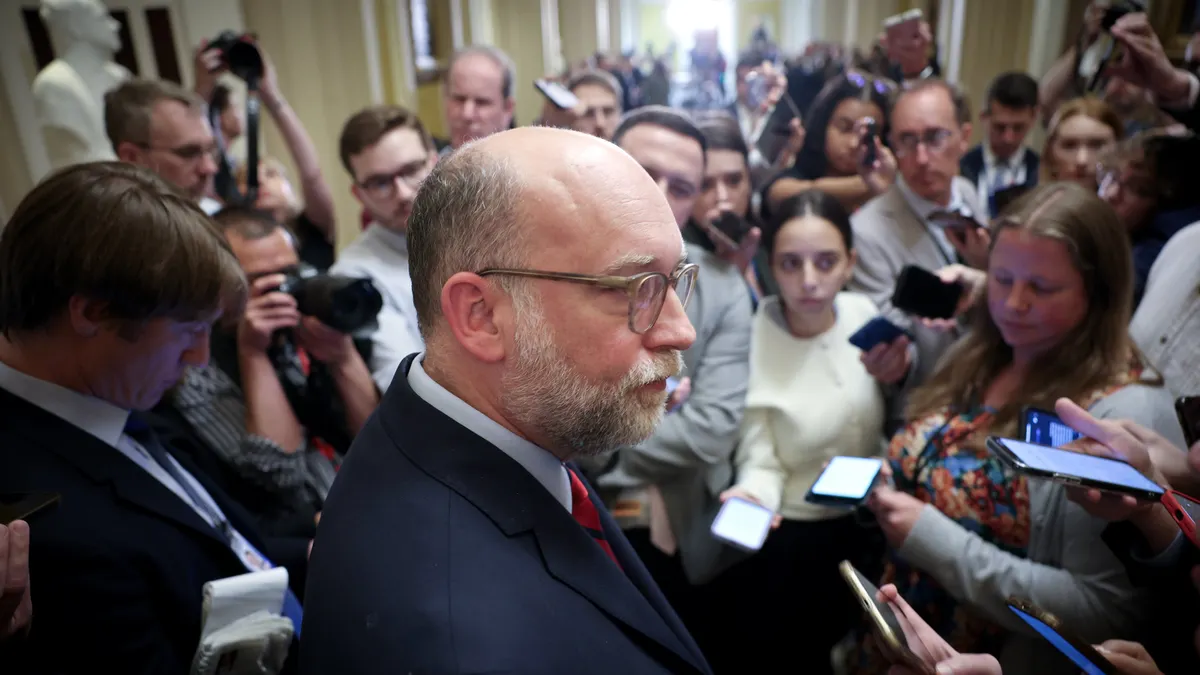
“The 2027 Budget builds on the President’s vision by continuing to constrain non-defense spending and reform the Federal Government,” Russell Vought, director of the Office of Management and Budget, wrote in the proposal.
The budget request suggests a number of cuts to health agencies. The NIH, the world’s largest public funder of biomedical research, would receive $41 billion, a decrease of $5 billion.
The proposal would eliminate the National Institute on Minority Health and Health Disparities, which supports reseach on health disparities in racial and ethnic minorities, people with low socioeconomic status and underserved rural communities, among other groups. The White House called the institute “replete with DEI expenditures” in the budget request.
Additionally, the White House wants to cut the NIH’s Fogarty International Center, which supports global health research, in part because the center funded Master’s degree programs in other countries. The National Center for Complementary and Integrative Health, which conducts research on alternative medicine, would also get the axe under the Trump administration’s proposal.
The budget request would also cut $4 billion from the Low Income Home Energy Assistance Program, arguing the initiative is unnecessary because many states have policies that prevent utility disconnection in low-income households or during extreme weather.
The Agency for Healthcare Research and Quality, which aims to research and promote safe healthcare delivery practices, would lose $129 million under the budget. Much of the agency’s research is “wasteful or duplicative of research conducted at NIH,” the White House said.
AHRQ has already faced significant cuts under the Trump administration. The agency has lost more than 50% of its staff since September 2024 as the HHS restructured and laid off thousands of workers.
The budget request also seeks to establish a new agency under the HHS. The Administration for a Healthy America was proposed last year to oversee areas like primary care and maternal health that are spread across agencies, but the AHA was never created — likely because it wasn’t authorized by Congress, sources told Healthcare Dive.
Now, the Trump administration is trying again, allocating $19 million under the AHA to expand access to nutrition services at health centers.
The White House says it will also save about $5 billion by consolidating and eliminating programs that were under the Health Resources and Services Administration, the Substance Abuse and Mental Health Services Administration, the Centers for Disease Control and Prevention and the Office of the Assistant Secretary for Health.
The HHS under the Trump administration has seen significant upheaval, including the loss of thousands of employees amid a major culling of the federal workforce.