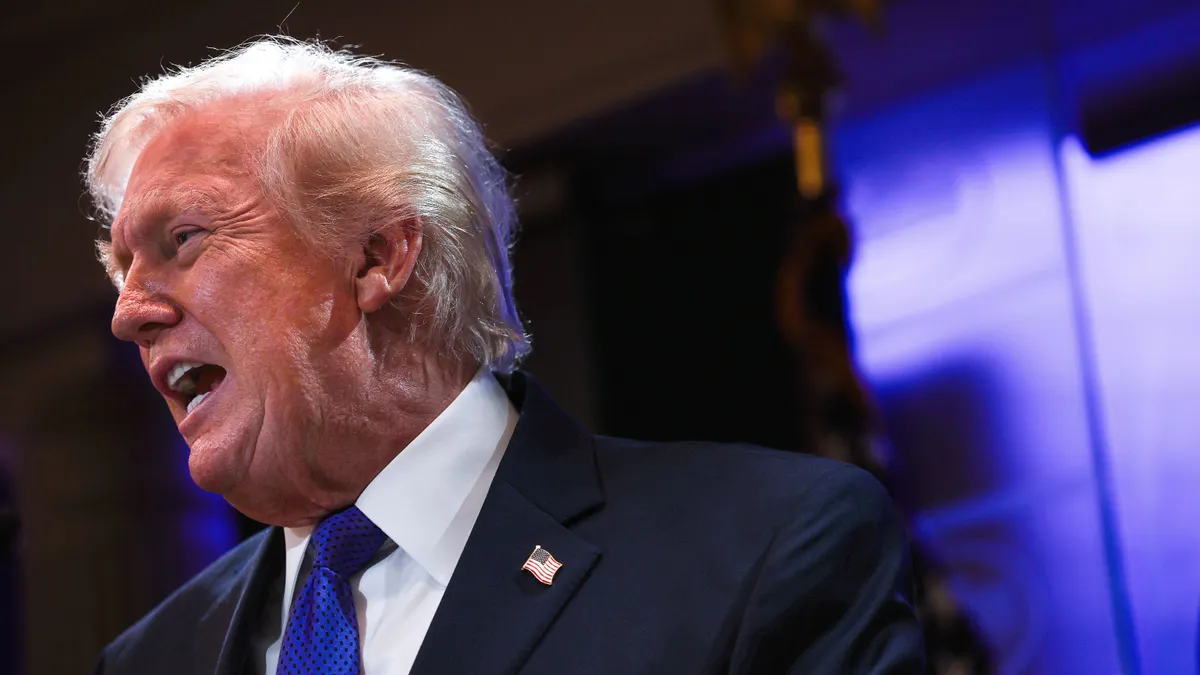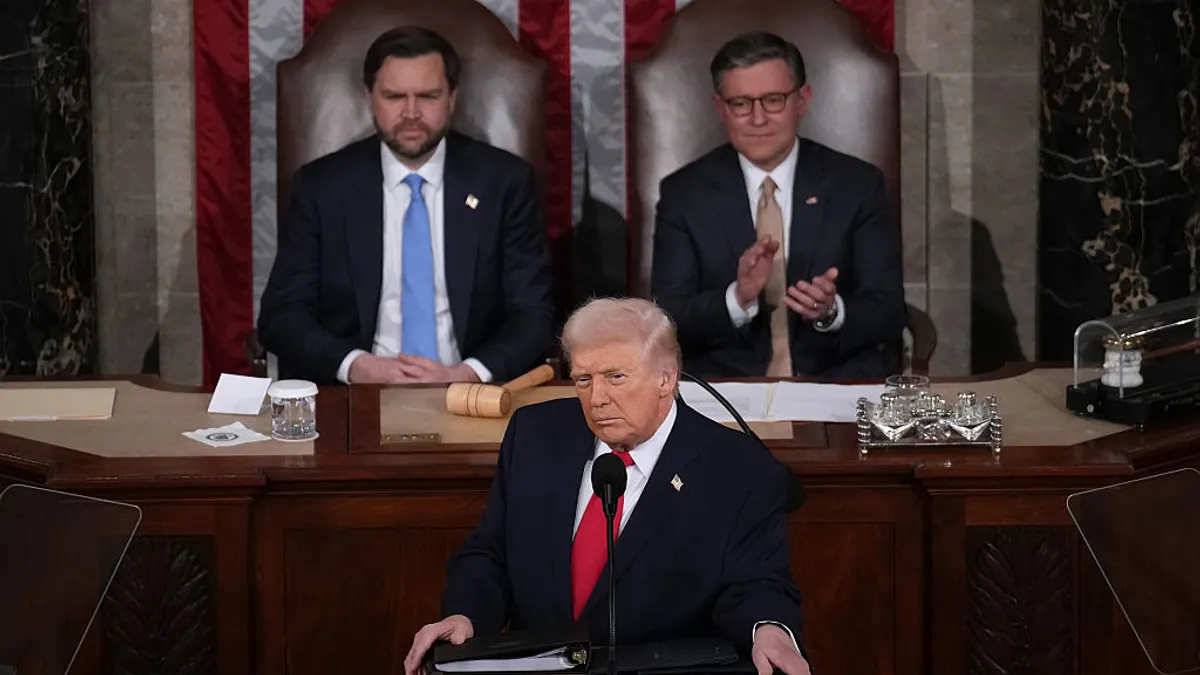
America has entered its “golden age,” President Donald Trump argued in a lengthy State of the Union address Tuesday night that glossed over the biggest achievements of the president’s second term so far but was notably light on healthcare.
The economy is improving, prices are coming down, illegal immigration is under control and crime is plummeting, the president said, while lauding guests in attendance like Erika Kirk and the Olympic gold medal-winning U.S. men’s hockey team. Trump’s remarks — the longest State of the Union speech in recorded history, at an hour and 47 minutes — were often met with chants of “U.S.A! U.S.A!” from Republicans in the gallery, and come as the president seeks to reverse plummeting approval ratings.
However, Trump didn’t use the State of the Union to introduce many new policy ideas. He also didn’t devote much time to healthcare, spending only about five minutes of his speech on the sector.
That’s despite the fact that the GOP plans to lean heavily on healthcare in its midterm pitch to voters, according to CNN. The party’s intensifying focus on healthcare issues slots into its larger push to convince Americans that Trump’s policies are bringing down the cost of living, including steep costs for pharmaceutical drugs, insurance premiums and medical care.
Healthcare costs top the list of American families’ economic anxieties, according to KFF polling last month. But Trump’s first mention of healthcare came more than a half hour into his address, when the president slammed the Affordable Care Act as a “rip-off” that allowed big insurance companies to get rich at the expense of American consumers.
Trump is a perennial critic of the ACA and the insurance marketplaces created by the Obama-era law. However, the president’s public barrages against the ACA ramped up last year, as Americans called for Washington to help them afford coverage after Republicans allowed more generous subsidies for ACA plans to expire.
In January, Trump proposed a health reform blueprint called the “Great Healthcare Plan,” which would redirect government subsidies in the Affordable Care Act marketplaces towards consumers, among other actions.
“I want to stop all payments to big insurance companies and instead give that money directly to the people so they can buy their own healthcare, which will be better healthcare at a much lower cost,” Trump said.
Details are vague on how this would be achieved. Experts also note the policy is unlikely to help needy Americans afford health insurance, at a time when families are taking on second jobs, draining retirement accounts or dropping coverage altogether in the face of skyrocketing premiums.
Still, Trump urged Congress to codify the plan, along price transparency requirements and the “Most Favored Nation” pharmaceutical deals the White House has negotiated with more than a dozen drugmakers to date. The MFN agreements tie U.S. pharmaceutical prices to lower prices abroad for certain drugs, and have led to Americans paying the lowest prices in the world for medications, the president said.
“I took prescription drugs, a very big part of healthcare, from the highest price in the entire world to the lowest. That’s a big achievement,” Trump said. Prices are down “300, 400, 500, 600% and more” as a result, according to the president.
The president also gave a shout-out to TrumpRx, his direct-to-consumer drug sales platform, which he argued was securing Americans deals on medications they wouldn’t otherwise be able to afford.
However, the president’s policies — though savvy politically, given Americans’ unhappiness with sky-high prescription drug prices — aren’t expected to have much of an impact on what most Americans pay for their drugs. MFN pricing only applies to state Medicaid programs and consumers paying cash, and participating companies have gone ahead and raised prices of hundreds of brand-name drugs this year anyways, according to NPR.
And despite the White House’s assurances, TrumpRx doesn’t always include the lowest available prices for drugs. Going through insurance, or pivoting to generic equivalents for a medication, may be cheaper.
Over the address, Trump also outlined how his administration is focused on cracking down on fraud in government programs and his belief that minors shouldn’t access gender-affirming care without parental consent.
The president did not touch on certain controversial healthcare issues, including his administration’s broadside against vaccine access, canceling or delaying of health research funding and downsizing of the HHS workforce.
Trump also didn’t address steep cuts to Medicaid in the GOP’s “Big Beautiful Bill” passed last summer.