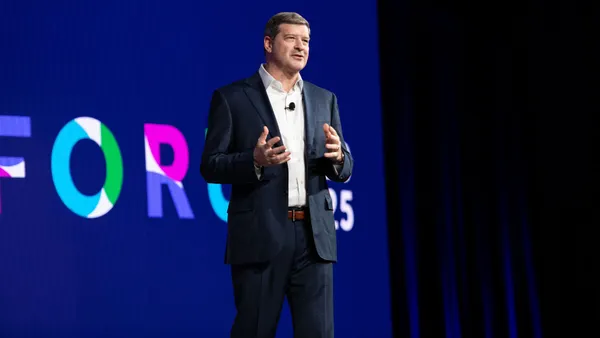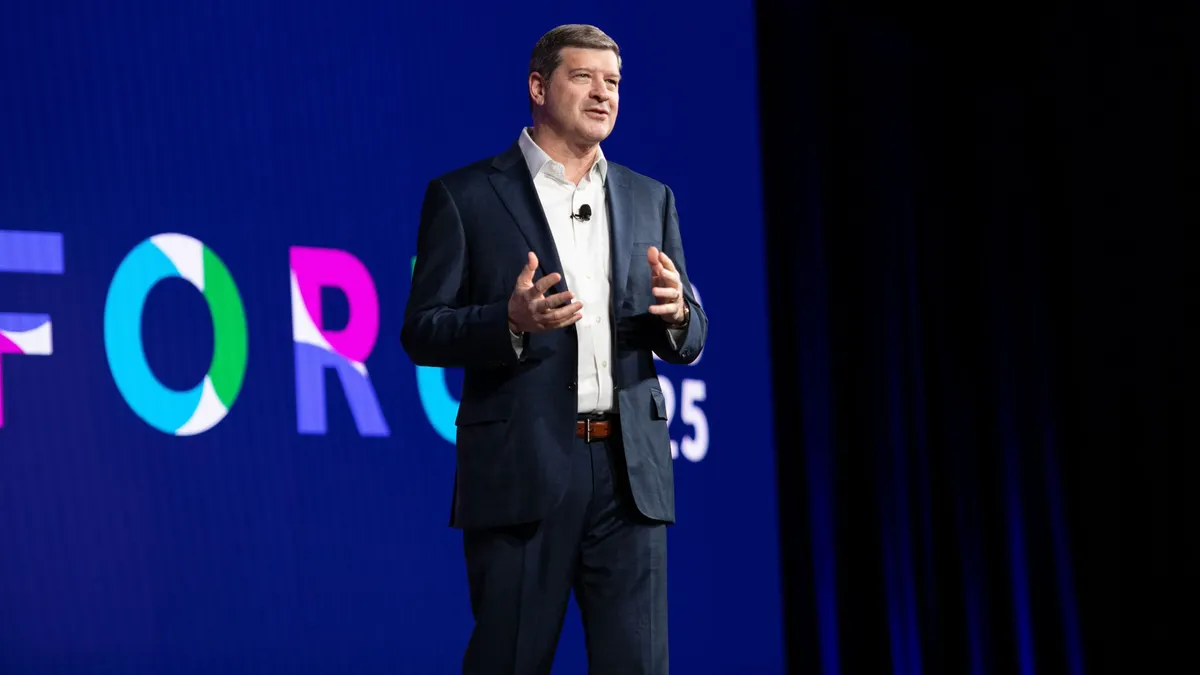
2026 is an “execution year” for Teladoc Health, CEO Chuck Divita told Healthcare Dive.
The telehealth company has spent the past year focusing on a strategy shift, prioritizing international expansion, improving operating efficiency, better leveraging its mental health assets and enhancing its integrated care business.
The goal is to deliver sustainable long-term growth at Teladoc, which has seen its stock price decline significantly from the heights reached during the COVID-19 pandemic. To that end, the virtual care giant completed multiple acquisitions last year, launched new products and began accepting insurance coverage at its direct-to-consumer mental health arm BetterHelp.
“I believe that we have the right strategy, the right priorities, and it’s really about execution now,” said Divita, who took up the role as Teladoc’s chief executive about a year and half ago.
Divita sat down with Healthcare Dive to discuss Teladoc’s progress over the past year, the telehealth firm’s M&A strategy and how the company is using artificial intelligence.
This interview has been edited for clarity and length.
HEALTHCARE DIVE: One initiative you’ve been focused on is accepting insurance at BetterHelp. How has that rollout been proceeding? I know it’s still relatively early, but are you seeing any signs that insurance coverage is improving enrollment and retention?
CHUCK DIVITA: The business has been under pressure, being a direct-to-consumer, cash pay model. So, thinking through, how do we create more value out of this business? And it was clear that moving into insurance was an important part of its future.
So we set that priority. We made the acquisition of a company called UpLift at the end of April 2025. And then within 60 days, we were in our first market with BetterHelp insurance in Virginia and in 12 states at the end of the year, plus D.C. So the scaling has gone well, the integration of UpLift has gone well, and we continue to focus on new states and rolling that up over the course of 2026.
It’s early in terms of some of the key metrics. But so far, I would say performance [is] in line with our expectations, what we thought would be occurring in terms of solid user conversion, number of sessions per user, those kinds of metrics. So in other words, the offering and the ability to use your insurance is delivering an ability for the consumer to maybe take the affordability thing off the table, or more off the table, and really focus on the therapy.
You mentioned the UpLift acquisition. I know you acquired multiple companies last year, including UpLift, Catapult Health and then Telecare in Australia. Do you anticipate more M&A this year? Has your strategy changed at all on what targets you might pursue?
M&A is a lever to advance and accelerate the strategy. That’s how we view M&A, and it’s how we view organic and internal investments as well.
We saw the need to accelerate the progress in BetterHelp entering insurance, and we found a great company in UpLift that brought us capabilities, talent and a baseline of network contracts. Catapult created and strengthened our offering in integrated care, in preventative care, as well as a new capability to reach people where they are and get them plugged into the healthcare system. And then Telecare, we saw an opportunity in Australia to strengthen our position.
So I think what you’ll see from us is a continued focus on M&A aligned with those priorities. And so far, I think the three deals that we’ve done give a good sense of how we think about it, how we execute it. And so far, all three acquisitions are performing really well.
You talked at the J.P. Morgan Healthcare Conference about how you’re using AI, like helping providers sift through patient information and document visits. Are there any areas where you don’t want AI involved? Or are there tasks you’d really like AI to help with but it just isn’t there yet?
We’ve been a pretty extensive user of AI in a number of different ways. Predominantly machine learning to predict demand and match patients and do a number of things to sort of engage people. And we’ve added a lot recently. I mentioned at J.P. Morgan our Pulse platform: Think about it as our data engine. We then can take not only our own data, which is extensive, but bring in other data sources and leverage AI against that to help identify trends and personalization.
I think certainly in the areas of efficiency, helping our clinicians administratively prepare for visits, document visits, those kinds of things. And the ability to leverage the data to see trends, to inform and help prepare our clinicians to intervene — all of those things are places where we’re going to continue to focus.
I think where we want to be cautious and make sure, from a responsible AI standpoint, is we want to arm our care providers to provide care, not replace our care providers. And I think that that’s the right place for us to be.
Some companies might offer a therapy or mental health chatbot. But you’re saying that you really want your providers to be humans.
I think AI can be a part of the care team and support patients with knowledge and interactions and insights and all the above. But we want our clinical providers ultimately being the ones that are providing patient care and having that human knowledge and human decision making.
Without appropriate guardrails or getting ahead of maybe where the technology is, it can produce the wrong outcomes for people. So I think we’re going to continue to evolve with the technology. But for us, it’s really around leveraging for the efficiency, the personalization, certainly supporting as a member of the care team. Our position right now is that the care providers are going to be the ones for sure making those decisions.