Dive Brief:
- State Medicaid programs will face “substantial impacts” over the next decade from the “Big Beautiful Bill,” including billions of dollars in reduced funding and falling enrollment in the safety-net insurance program, according to an analysis published last week by nonprofit research organization Rand.
- States’ Medicaid budgets are projected to decline by $664 billion between 2025 and 2034 due to the massive tax and policy law enacted last summer, which included significant Medicaid cuts and healthcare policy changes.
- Twenty states are expected to see Medicaid budget reductions of 5% or more, according to Rand. Additionally, 7.6 million fewer people will be enrolled in the insurance program in 2034 due to provisions like work requirements for beneficiaries.
Dive Insight:
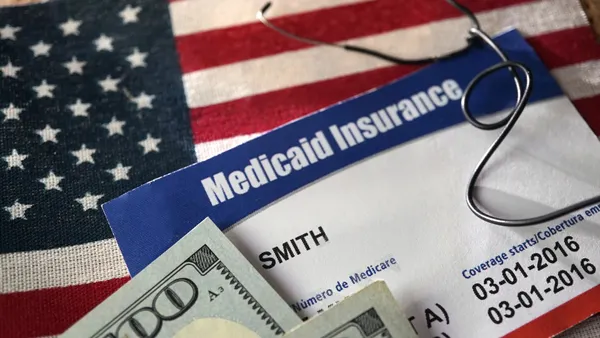
The One Big Beautiful Bill Act is a sweeping law that includes significant healthcare policy changes — particularly for Medicaid, the insurance program for low-income Americans jointly funded by states and the federal government.
Among other changes, the law will mandate that many Medicaid adults report at least 80 hours of work, community service or education per month to stay enrolled in the program.
Additionally, it requires states to conduct eligibility checks more frequently, increase cost-sharing for some services and limit their use of provider taxes, where states levy taxes on healthcare organizations to help fund their share of Medicaid spending. State-directed payments, financial arrangements that allow states to send supplemental payments to Medicaid providers, will be curtailed under the law too.
Millions of people will likely lose Medicaid coverage due to the law, with Medicaid work requirements impacting enrollment in the safety-net insurance the most, according to the Rand analysis, which modeled the impacts of 12 provisions of the law.
West Virginia, New Mexico, Oregon and Washington, D.C., are projected to see enrollment declines of more than 20%, according to the study.
Overall, states’ general funds — the primary fund for state operations — are projected to decline by $87 billion from 2025 through 2034 due to the law, according to Rand. Meanwhile, the federal government will save $714 billion over the same time period.
The impact of the tax and policy legislation will vary across states, according to the analysis. For example, states that have expanded Medicaid and extensively use provider taxes and state-directed payments are likely to be hit the hardest.
Arizona, Iowa and Nevada could see their Medicaid budgets reduced by more than 15%. California and New York will see the largest cuts in dollar value to their Medicaid budgets, at $112 billion and $63 billion, respectively.
Meanwhile, states like Florida, North Dakota and Nebraska will see minimal impacts on their Medicaid budgets, given they don’t rely heavily on provider taxes or state-directed payments, according to Rand.
Wyoming and South Dakota could experience increases in their Medicaid budgets. These states have small populations, so they could see funding increases from the Rural Health Transformation Program, a $50 billion fund that was added to the Big Beautiful Bill shortly before it passed to win over some Republican holdouts.
Some of the law’s provisions will also generate savings to states’ general funds by reducing Medicaid enrollment or health care utilization, according to Rand.
“The effects of the law on Medicaid budgets and enrollment are substantial, but will vary widely across states, and in some cases may be at least partially offset by savings to the state general fund,” Preethi Rao, a senior economist at Rand and lead author of the study, said in a statement. “Some states will see significant reductions in Medicaid funding and enrollment, while others may experience relatively limited changes depending on how their programs are structured and financed.”