Artificial intelligence has dominated much of the conversation on healthcare technology over the past three years.
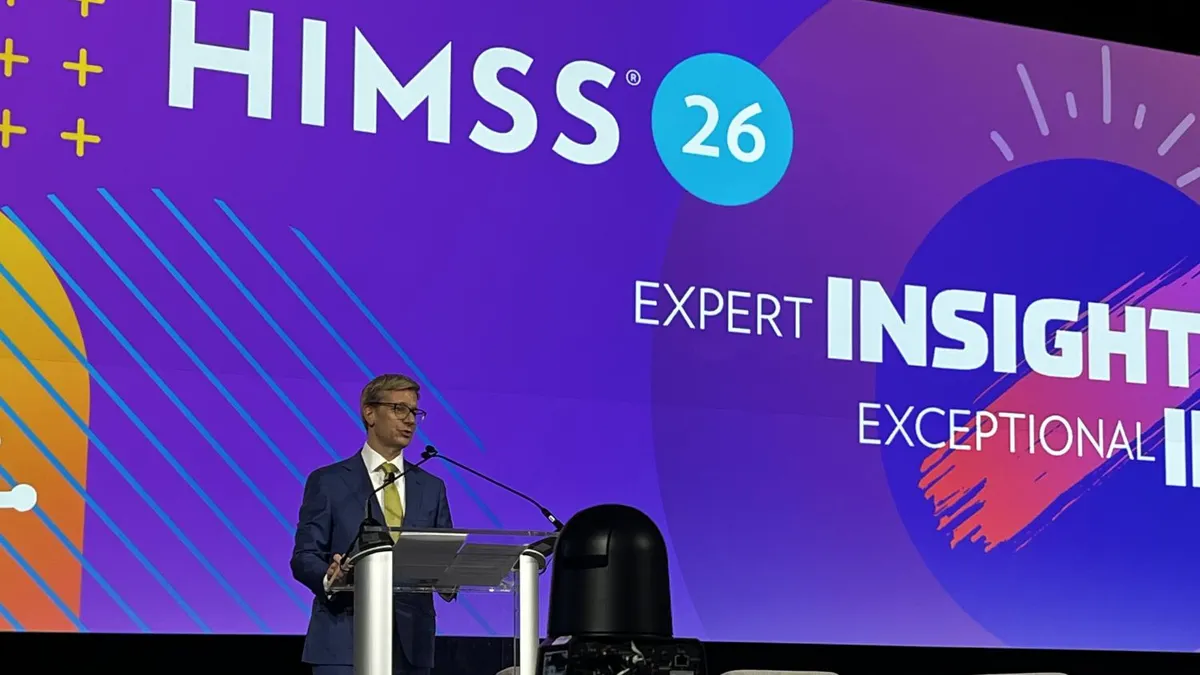
That trend continued at the HIMSS conference in Las Vegas last week. The sector is hopeful AI could assist with major challenges like workforce shortages, burnout and an aging population that needs more care.
As the technology rapidly advances, the industry is increasingly adopting AI agents that can act more autonomously and updating their governance strategies to keep up with the rapid pace of innovation, experts said at HIMSS. Those agents could be a cybersecurity risk, and health systems will need to pay close attention to how they verify non-human users of their systems.
Plus, electronic health record vendors are doubling down on their own AI offerings — though the companies say their provider customers will still be able to integrate third-party AI products into their records systems.
These are the five biggest takeaways from the conference:
1) The rise of AI agents
AI agents, or AI systems that can act more autonomously and handle complex, multi-step tasks, will increasingly be deployed in the healthcare sector this year as the technology advances, experts said.
The industry faces a significant burden of back-office work that could be handled by agents independently, like onboarding new workers, managing the claims and reimbursement process, and helping patients schedule appointments and navigate their care, said Aashima Gupta, global director for healthcare solutions at Google Cloud.
That work is costly and labor-intensive. Clinicians have long said administrative tasks distract from patient care, drag into after-work hours and increase burnout. And administrative work is expensive for the industry as a whole, accounting for up to one-quarter of healthcare expenditures in the U.S., research shows.
Now, agents are rapidly becoming more advanced in their reasoning and decision-making capabilities, said Puneet Maheshwari, senior vice president and general manager of Optum Real, Optum’s new AI system for claims reimbursement.
Healthcare reimbursement and claims processing often takes a long time to complete, he said. Clinicians document the care they provided, and coders check their work for errors — potentially sending those encounters back to the provider if they flag concerns. Claims clearinghouses might also return claims if they see missing information or mistakes.
And by the time claims arrive at payers, weeks may have elapsed. It could take another 28 days for providers to get paid, he said. As AI agents advance, they could execute a multi-step workflow on their own, experts said.
“Autonomous agents will become more and more proficient and will be utilized more and more across the board,” Maheshwari said.
2) Interoperability isn’t optional
The ease of health data exchange has been a long-term challenge for the healthcare industry, complicated by siloed information that doesn’t easily flow between providers and a reliance on dated technology like fax machines.
Interoperability is key if healthcare organizations want to take advantage of AI tools, as the technology is only as good as the data it’s trained on, experts said.
As the sector moves to adopt agents, providers are being forced to take a hard look at their data, said Edwina Bhaskaran, chief clinical systems and informatics officer at Mayo Clinic. They need to examine data quality, where it’s stored and whether agents can easily pull information from different sources.
“This happens quite often, you still have to have someone call over and say, ‘Can you fax me records?’” she said. “So while there’s a lot of data that we do share, there’s still quite a bit of data that we don’t.”
The federal government is also prioritizing data liquidity, Dr. Thomas Keane, assistant secretary for technology policy and the national coordinator for health information technology, said during a presentation at HIMSS. Treating patients without a full picture of their health background can lead to medication errors, care gaps and adverse events, he said.
Plus, the wealth of data generated in the U.S. healthcare system can now be effectively analyzed with AI to improve diagnosis and treatment, pushing healthcare to focus on interoperability, said Greg Samios, CEO of information services and software firm Wolters Kluwer Health. The sector has often been overwhelmed by data that couldn’t easily be used.
“Grassroots pressure often drives this more than anything else,” he said. “And now that there’s an ability through a lot of the AI technology to leverage this data to make a real difference for your life and my life, I feel like that pressure might force that issue a bit more.”
3) EHR vendors tout AI tools
Electronic health record vendors are rolling out suites of AI tools to their customers, adding new competition for startups and health tech firms.
Providers are already reliant on EHRs, so it’s likely easier for them to implement products from their vendors. More than 85% of Epic’s customers use their AI products, including tools for drafting discharge summaries, documenting patient care and revenue cycle management, the market-leading EHR vendor said at HIMSS.
Meditech, another large EHR vendor, is also expanding its AI offerings, including an ambient scribe for physicians and nurses, an agent that can help manage claims denials and appeals, and a tool that lets clinicians query patients’ records.
EHRs are key to physicians’ workflow, so integration with the health record is often important for adopting AI products, experts said. Plus, the EHR already holds the health system’s data, so it can offer a better quality output, said Sarah Hatchett, chief information officer at Cleveland Clinic.
Competing AI products will still be able to integrate with their EHRs, leaders at Epic and Meditech said. Epic is building capabilities, but the firm also wants to “give our customers the choice” and keep options open if they prefer another product, said Seth Howard, Epic’s vice president of research and development.
Meditech also allows health systems to integrate other AI tools with their records system, said Chief Operating Officer Helen Waters.
“If I’m asking you for an investment of millions of dollars, you should ask of me the ability to take that investment and do what you choose with it,” she said. “We’ll have a free opportunity to compete for their business, but we cannot control their business, neither should we.”
4) AI governance shifts from priority to practice
Although experts have emphasized the importance of AI governance in the past, vendors and health systems this year said they were focused on evolving, refining and innovating their AI governance structures.
As AI tools mature, healthcare organizations need to evolve their AI governance structures, according to Jane Moran, chief information and digital officer at Mass General Brigham. Static governance is not an option in the face of rapidly evolving AI tools.
“We’re finding these tools are super easy to use. You can go out and just get OpenAI or Claude or Perplexity or whatever and start to use it. And so, what we found in terms of governance was that we actually needed to do more education with our employees about safety and security and keeping our patient data private,” Moran said in an interview.
Dr. Ed Lee, chief medical officer at Nabla, an ambient AI scribe for clinical documentation, also stressed the importance of having a governance structure with the ability to adapt to new innovations.
There should be different tiers of governance for different use cases, Lee said. Administrative tools do not necessarily need the same guardrails as those that touch clinical care.
The rise of agentic AI has further amplified healthcare's need to maintain nimble governance structures.
“Especially as we’re talking and moving into things like agentic AI, where things are potentially happening in an autonomous way, there may be even further guardrails so that we don't do the wrong thing,” Lee said. “We always have the patient’s wellbeing in mind and safety and quality are of most importance.”
Throughout HIMSS, experts discussed the need to level up AI governance in healthcare and expanded on the tangible ways they are doing so — with structured frameworks, tiered guardrails and user-friendly tools.
“What I see in different organizations is a reflection of maturity and the discipline to do the mundane tasks that establish foundational elements of governance,” Skip Sorrels, field chief technical officer and chief information security officer at cybersecurity company Claroty, said in an interview. “And the ones that do that well, I put in the category of quite mature and usually having a higher level of governance, versus the opposite end of the spectrum, where it’s like, ‘Yeah, we have governance, but we haven’t done anything with governance.’”
“And unfortunately, I do think there are still some out there that kind of have their heads in the sand,” he said.
5) Healthcare faces the challenge of AI agent identity management
Healthcare is confronting the rise of non-human identities in its AI systems, as AI agents are increasingly deployed in administrative, clinical and operational settings. As these agents gain autonomy, robust identity management programs are needed to prevent unauthorized access to sensitive systems or data.
Russell Teague, chief strategy and security officer at Fortified Health Security, a company that offers advisory services and threat defense capabilities, said he’s still waiting to see how agentic AI plays out.
“From a security perspective for healthcare, we’re going to have to pay close, close attention to identities, both human and non-human,” Teague said.
Vendors are already trying to corner the agent identity management market. At HIMSS, the digital identity and access management company Imprivata introduced Agentic Identity Management, a new set of capabilities in its platform designed specifically to govern AI agents.
“It’s a complex need to have someone not from your system who’s not your employee come in. And you don’t want to give them the keys to the castle. So, you have to do things like govern exactly how and when and where and why they're going into a system,” said Dr. Sean Kelly, chief medical officer at Imprivata and emergency physician at Beth Israel Deaconess Medical Center.
“And that becomes very important when you start talking about non-human ID. So now if you have agentic agents doing things in healthcare, it's a very complex and messy situation.”
Healthcare is hastily adopting agentic AI tools, Kelly said, given the tech’s promise of enabling efficiency and better care outcomes.
“The problem is that leaves you very vulnerable because it's even harder than human identity to control and to understand,” he noted.