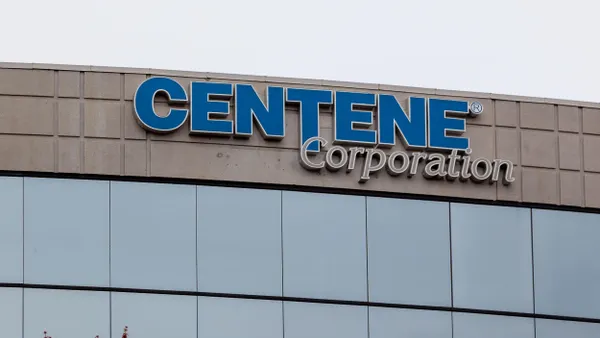
Centene issued a higher earnings outlook for 2026 than analysts expected, while beating Wall Street forecasts for earnings and revenue in the fourth quarter — a rare outperformance during a difficult season for health insurers with a heavy presence in government programs.
Centene expects adjusted diluted earnings per share of at least $3 in 2026, up from $2.08 in 2025. However, the payer’s revenue outlook of $188.5 billion at the midpoint is lower both than analysts’ expectations and the $194.8 billion in revenue that Centene brought in last year.
The revenue contraction is mostly due to shrinking premiums in Centene’s Affordable Care Act business, as Americans exit the ACA exchanges amid skyrocketing costs for coverage, executives said.
Still, Centene’s improved profit outlook suggests the government programs giant will manage to stabilize elevated medical costs this year.
So far, it’s been a brutal earnings season for managed care companies, mostly due to grim forecasts of lower profits in 2026. Elevance and Molina both expect their earnings to drop this year, as it remains difficult to turn a profit in programs like Medicaid and the ACA.
In Medicaid, states’ payment rates haven’t kept pace with elevated costs of care. Acuity has also been rising in ACA plans. And sharp premium increases for coverage this year have set off turmoil in the exchanges, with some enrollees exiting the ACA markets entirely and many of those remaining electing for cheaper but less comprehensive bronze plans.
Centene is the largest Medicaid managed care company in the U.S., and the biggest provider of coverage on the ACA exchanges. As such, it has outsized exposure to the markets. But executives at the St. Louis-based payer said it should be able to leave out-of-control medical spending behind it in the new year.
“While 2025 was undeniably challenging, disciplined execution enabled us to close the year slightly ahead of [our] expectations,” CEO Sarah London said on a Friday morning call with investors.
Centene closes 2025, looks ahead
Centene beat analyst expectations for earnings and revenue in the fourth quarter, posting a topline of $49.7 billion, up 22% year over year. Though, the company posted a net loss of $1.1 billion compared to a gain of $283 million the same time last year, amid elevated medical spending.
Centene lodged a medical loss ratio of 94.3% in the quarter, well above 89.6% the same time last year and higher than analysts expected.
Centene chalked the higher MLR up to ACA members being sicker than expected, driving up medical spending. Centene also recorded expenses in the quarter related to rising No Surprises Act billing disputes that pushed the MLR up, London said.
“While the No Surprises Act was designed to protect consumers, it has increasingly become weaponized by market participants looking to extract profits,” London said. “We are vocal for advocating for NSA reform and in the meantime will be taking a more proactive litigious posture when necessary,” including a multi-million dollar lawsuit Centene filed earlier this week against a New York provider for allegedly gaming the dispute resolution system.
Centene’s Medicare Advantage business was also pressured by higher spending in the quarter. But importantly, the profitability of Centene’s Medicaid business— the company’s bread and butter — improved.
Higher medical spending on behavioral health, home health and high-cost drugs were offset by stronger rate and revenue increases, executives said.
Centene’s outlook for 2026 assumes Medicaid margins stay flat — a relatively sunny prediction and somewhat of an outlier, given its peers in the safety-net insurance program are ringing warning bells about margin compression.
Centene released its guidance one day after Molina forecast its profit in 2026 would be less than half of what analysts expected, sending shares in the company plummeting 33%. Molina also posted significant miss on its fourth-quarter earnings, with medical costs hitting its Medicaid, MA and ACA businesses more drastically than expected.
Molina also said it would stop offering MA plans with drug coverage for 2027, arguing that the business was underperforming and dragging down its earnings potential.
Centene’s results “will provide some relief for investors after [Molina’s] announcement after the close last night,” J.P Morgan analyst John Stansel wrote in a note on Friday.
Still, analysts are wary that the pressures called out by Molina may not be unique to that company, and pressed Centene executives on the stark differences between their outlooks.
When asked on the call, London noted that Centene closed 2025 with Medicaid rates 5.5% above 2024’s levels, which is a better jumping off point for reimbursement this year. Centene expects its composite rate increase this year to be 4.5%, but that could continue to rise throughout 2026. And that should still cover higher trend when combined with actions Centene’s taken to keep a lid on spending, like removing providers that seem to be overbilling from its network, according to the CEO.
“That momentum I think is really important,” London said.
Centene expects to end the first quarter with 3.5 million ACA enrollees, down from 5.5 million at the end of 2025, once members not paying any premiums are filtered out. It’s a sharp reduction for the company, but one Centene expected after raising its ACA premiums on average in the mid-30% range for 2026.
Notably, more of its remaining members will be in bronze plans this year. Bronze enrollees will make up more than 30% of Centene’s ACA membership, compared to between 19% and 24% over the past few years, according to executives.
Analysts seemed concerned about that evolution on the call, given bronze plans normally come with more volatile margins.
But based on early data from 2026, Centene is seeing “nothing alarming” from its increase in bronze members, London said.
Centene also expects to progress towards its goal of break-even margins in MA this year, and plans to submit comments to the CMS on the agency’s “disappointing” rate notice for 2027, CFO Drew Asher said.
Centene has also agreed to sell its remaining Magellan Health care management businesses, the company said in its earnings report, signing a definitive agreement to do so in December. The report did not share the buyer.
Centene previously sold Magellan’s pharmacy and utilization management units.