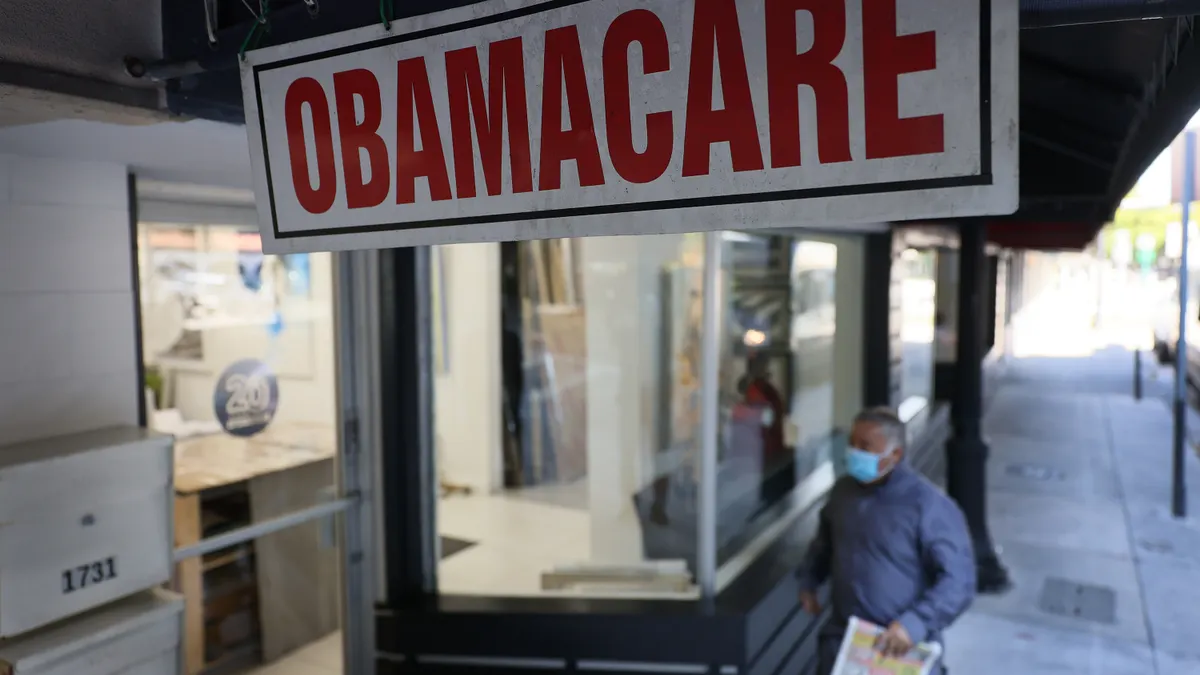
Republicans have fresh ammunition to argue that the Affordable Care Act exchanges are dotted with fraud thanks to a new report from a government watchdog.
It’s easy to get around guardrails in the ACA exchanges meant to prevent improper enrollments, according to the Government Accountability Office’s preliminary findings from months of investigation published on Wednesday.
GAO investigators arrived at their conclusions after successfully enrolling almost 20 fake individuals in subsidized coverage and reviewing marketplace data over the last few years.
The watchdog’s report is not evidence of the rampant fraud asserted by some conservatives. Still, it’s being used as fodder for the GOP as the party resists a clean extension of more generous ACA subsidies set to expire at the end of the year.
ACA vulnerable to fraudsters
Republicans have long beat the drum about widespread fraud in the ACA exchanges, describing a system plagued with bad actors and deception. Fraud certainly exists, though evidence is mixed about the scale of the issue.
Allegations of endemic fraud in the exchanges have been refuted by health policy experts and industry groups, though most stakeholders support improving program integrity.
But the exchanges do have structural weaknesses that make catching fraud tricky, according to the GAO’s new report.
The GAO created 20 fake personas and submitted them for subsidized ACA coverage. Nineteen of the 20 fictitious applications were approved for coverage in 2025. As of September, 18 of those “applicants” were still receiving coverage, costing the federal government a total of $10,000 per month in fraudulent subsidies, according to the report.
The fake applications snuck through despite marketplace controls meant to prevent improper enrollments, including identity verification requirements and screens for application inconsistencies, the GAO said.
The watchdog also found more than $21 billion in subsidies that went to consumers with Social Security numbers who didn’t reconcile their eligibility for financial assistance with their actual income in 2023.
The sum likely isn’t all overpayments — but it isn’t a great sign, given Social Security numbers can be misused, the GAO said.
For example, more than 29,000 Social Security numbers were tied to coverage that lasted longer than a year in 2023, according to the report. The most frequently used Social Security number received subsidized insurance coverage for more than 26,000 days — more than 71 years of coverage — across more than 125 insurance policies.
That overuse can occur because of identity theft or synthetic identity fraud, which is when fake information is combined with real information to make fraud more believable, the GAO said.
Investigators also found that 26,000 Social Security numbers used to get coverage in 2023 were attached to people who had died. The government sent more than $94 million in subsidies to those households.
CMS officials told the GAO that they allow the marketplace to enroll the same Social Security number for more than one plan to ensure the actual holder of that number can enroll in coverage even if their identity has been stolen. They also review the marketplace monthly to catch duplicate enrollments.
Similarly, the marketplace checks death status when people apply and twice a year through data matching, CMS officials said. However, the marketplace doesn’t cut off coverage for dead people in households with multiple members, according to the report.
The GAO said that it plans to continue reviewing the CMS’ auditing practices and the marketplace’s controls.
The watchdog also dug into the role that insurance agents and brokers play in creating or perpetuating fraud. The intermediaries, which help people find and sign up for coverage, work on commission from insurance companies, giving them a financial incentive to enroll as many people as possible.
At least 30,000 ACA applications in 2023 and 160,000 applications in 2024 “had likely unauthorized changes,” the GAO wrote in its analysis.
“While only one enrollment change may go into effect for a given month, the volume of these actions indicates potential misconduct,” GAO said. “Beyond legitimate enrollments, this may include making unauthorized changes to existing enrollments, enrolling consumers without their knowledge or consent, and creating fictitious enrollments.”
Another concern is that brokers previously suspended by the CMS have been allowed to return to the exchanges.
In October, the CMS said it had suspended 850 brokers for “reasonable suspicion of fraudulent or abusive conduct.” However, CMS officials told the GAO in May that the suspended individuals had been reinstated “to better fulfill the agency’s statutory and regulatory procedures.”
Though the GAO’s testing found poor enrollment controls, the watchdog stressed that the tests are ongoing and can’t be generalized to the larger ACA population.
Still, it comes at a weighty time for the future of the exchanges. Conservatives have pointed to rampant fraud as one reason that enhanced subsidies for ACA plans enacted during the coronavirus pandemic should be allowed to lapse at the end of this year.
The GAO report reaffirmed that position for some Republicans, according to Politico reporting.
Enhanced subsidies allowed higher-income individuals to receive financial assistance for the first time and increased the amount of assistance for low-income individuals. They’re credited with swelling record enrollment in the exchanges. If they expire at the end of 2025, premiums for ACA plans are set to double on average and an estimated 4 million people will become uninsured.
Democrats support a clean extension of the subsidies for at least one year, to protect consumers from the Jan. 1 cliff and give Congress time to debate broader reforms to make healthcare more affordable. They secured a promise from Senate Republicans to vote on a subsidy bill in mid-December.
However, many Republicans would prefer allowing the subsidies to expire, making a bipartisan deal look increasingly unlikely.