Dive Brief:
- Senate Democrats’ plan to extend more generous financial assistance for Affordable Care Act plans would increase the federal deficit by nearly $83 billion over a decade, but millions more would remain insured, according to an analysis by the Congressional Budget Office released Wednesday.
- Keeping the enhanced subsidies in place through 2028 would increase the number of people with health insurance by 400,000 next year, 3 million in 2027, 4 million in 2028 and 1.1 million in 2029 compared to if the assistance is allowed to expire, according to the nonpartisan budget scorekeeper.
- The extension — along with a competing Republican proposal that would send funds directly to health savings accounts tied to high-deductible ACA plans — is set to go up for a vote Thursday. Still, neither bill is expected to pass.
Dive Insight:
The looming deadline to address the expiration of enhanced ACA subsidies has become a major issue for lawmakers.
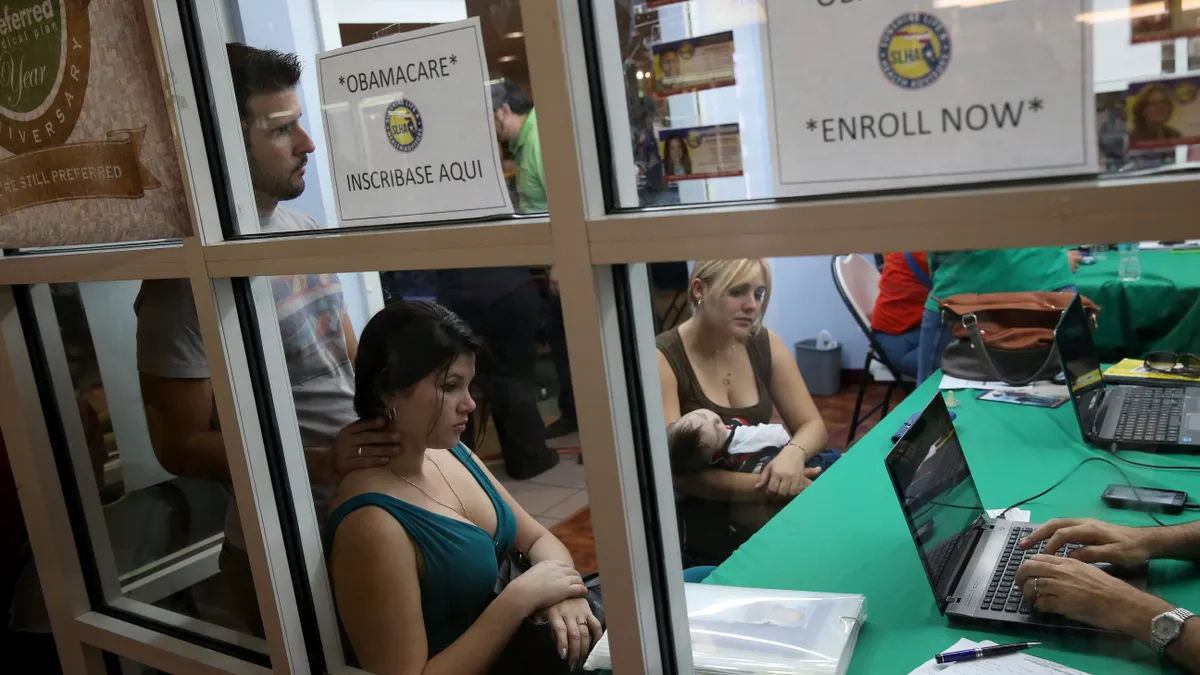
The future of the expanded financial assistance, which have allowed many low-income ACA beneficiaries to pay nothing for health plans while improving affordability for middle-income enrollees, was at the center of a historically long government shutdown this fall. However, the impasse ended without a deal.
Without congressional action, the enhanced subsidies are set to expire on Dec. 31.
Allowing the enhanced subsidies to lapse will cause premiums to more than double, pushing millions to leave the exchanges as costs rise and increasing the number of uninsured Americans, according to previous CBO estimates.
But many Republicans oppose an extension, noting the high cost of the financial assistance and the risk of fraud on the ACA exchanges.
Conservative lawmakers have released a number of proposals to manage the looming healthcare cost spike, including a bill from Sens. Mike Crapo, R-Idaho, and Bill Cassidy, R-La., that would replace the increased subsidies with money sent directly to HSAs tied to bronze and catastrophic exchange plans.
But the enrollment period for ACA exchange plans has been underway for weeks, and premiums are already locked in for the 2026 plan year. Even if Congress were to pass the three-year subsidy extension supported by Senate Democrats, gross premiums for benchmark plans on the marketplace would be unchanged next year compared with current law, according to the CBO.
Still, an extension would still shield consumers from steep hikes in the monthly payment for their plan, given the ACA caps how much subsidized enrollees pay for premiums at a certain percent of their income.
And, gross premiums would be 5.7% lower in 2027, 9% lower in 2028 and 3.3% lower in 2029 if the subsidies are extended for three years.
“The estimated decline for benchmark premiums arises from the expectation that, on average, people who enroll in the marketplaces would be healthier than would be the case without the extension,” CBO wrote in the analysis.